50 Believe Nothing Is Impossible Quotes for the Days You Need a New Way Forward
“Nothing is impossible” can be a wonderful thing to hear when you’re about to try something new. It can also be frustrating when you’re facing a problem that won’t disappear just because you think positively.
Both reactions make sense.
A difficult goal may require money you don’t have yet, skills you’re still learning, help you haven’t found, or time you can’t spare right now. Sometimes the obstacle is real. Sometimes the goal itself needs to change. A useful quote won’t erase any of that. What it can do is help you pause long enough to ask a better question: Is this truly impossible, or do I need a different next step?
That’s how to use this collection. It isn’t a promise that every dream will come true. It’s a place to find words for starting, trying again, changing direction, or simply getting through a hard day.
Below are five quotations linked to sources where you can check them, followed by 45 short editorial lines written for this article. The editorial lines aren’t presented as sayings by historical figures or anonymous quotations collected from elsewhere. Browse the section that fits your situation, and take only what helps.
Five Sourced Quotes About Possibility and Starting Again
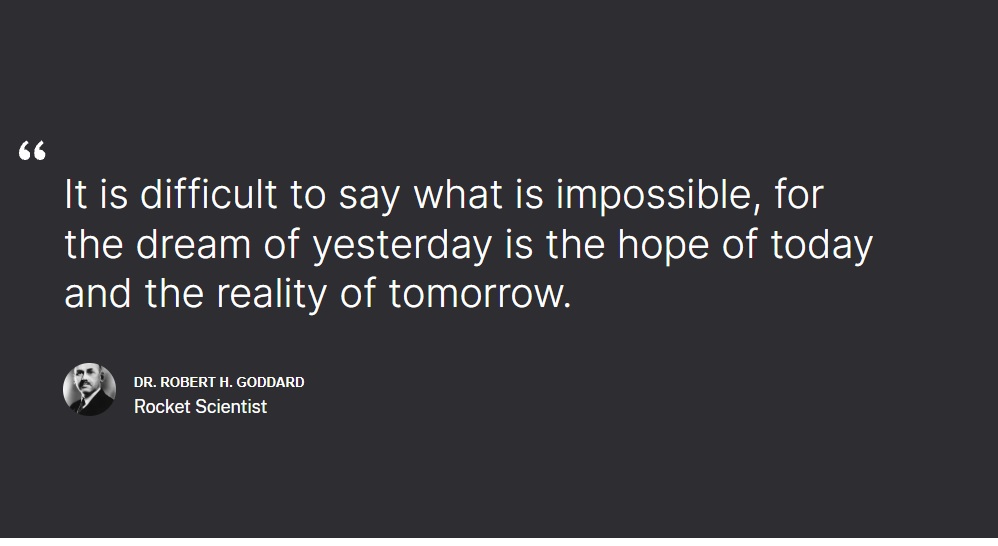
- “It is difficult to say what is impossible, for the dream of yesterday is the hope of today and the reality of tomorrow.” — Robert H. Goddard, as quoted by NASA
- “It is impossible to live without failing at something.” — J.K. Rowling, in her Harvard commencement address
- “You can’t connect the dots looking forward. You can only connect them looking backwards.” — Steve Jobs, in his Stanford commencement address
- “The only thing we have to fear is fear itself.” — Franklin D. Roosevelt, in his first inaugural address
- “I dwell in Possibility -” — Emily Dickinson, in her poem of the same opening line
These lines are often placed next to one another on quote pages, but they weren’t written for the same moment. Goddard was a rocket scientist considering what future discoveries might allow. Rowling was speaking to graduates about failure. Roosevelt addressed a country in the midst of an economic crisis; he wasn’t saying that its problems were imaginary.
Context makes a quote more useful, not less inspiring. Goddard’s words might invite you to question an assumption. Rowling’s might help you stop treating one failed attempt as an unusual personal defect. Jobs’s might remind you that not every experience will make sense while you’re living through it.
None of them can tell you exactly what to do. You still get to decide which words fit your life.
Quotes for Starting Something That Feels Too Big
The lines from this point onward are editorial lines for this article, not quotations attributed to public figures.
- “You don’t need to know the whole route to take the next turn.”
- “A small beginning still counts as a beginning.”
- “Make the first step small enough to try, not impressive enough to announce.”
- “Start with what you can reach from where you are.”
- “Unfamiliar doesn’t always mean impossible.”
- “The first draft is allowed to look like a first draft.”
- “If the big plan freezes you, make a smaller one.”
- “You can begin before you feel certain.”
Starting often feels hardest when you’re imagining the finished version of a goal. You want to write a book, so you picture an entire manuscript. You want a different career, so you picture interviews, training, and explaining your decision to everyone you know. You want to get healthier, so you picture a routine that barely fits your life.
Looking at the whole project at once can make the first action seem too small to matter. But small actions are often where you learn what the project will actually require.
Suppose you want to take a class. “Go back to school” is a big, complicated plan. “Find out whether the program offers evening classes” is a question you can answer. The answer may bring up another obstacle—cost, transportation, childcare, or energy. That doesn’t make your first step pointless. It gives you better information than worrying about every possibility at once.
Quote 8 is useful here: “Make the first step small enough to try, not impressive enough to announce.” You don’t need to tell the world you’re changing your life. You can research one option, make one call, or spend 20 minutes practicing a skill.
If you’d like more ideas that don’t require an overnight transformation, see our guide to small ways to improve yourself every day. Choose what fits; you don’t need to adopt every suggestion.
Quotes for When You Tried and It Didn’t Work
- “A disappointing result can tell you what to change; it cannot tell you your worth.”
- “You can be upset about what happened and still look for another option.”
- “Trying again is one choice. Changing direction is another.”
- “A setback deserves a closer look, not an automatic verdict on your future.”
- “Take what the attempt taught you. Leave behind the insult you added to it.”
- “You’re allowed to rest before you decide what comes next.”
- “An ending you didn’t want can still leave room for another beginning.”
- “The useful question may be ‘What happened?’ rather than ‘What’s wrong with me?’”
Some motivational advice moves past disappointment too quickly. It tells you to be grateful for the lesson before you’ve had time to acknowledge what the setback cost. But losing an opportunity can hurt. A rejected application may affect your finances. An unsuccessful project may represent months of effort. You don’t have to call the experience a gift.
You also don’t have to turn it into a judgment about who you are.
Take a job rejection. You might learn that another applicant had experience you don’t have yet. You might discover that your application didn’t show your skills clearly. Or you might never learn why the employer made its decision. Those possibilities lead to different next steps. None requires the conclusion, I’ll never get hired anywhere.
Quote 21 offers a place to begin: What happened? Write down what you know, what you’re guessing, and what you might do differently. That may mean seeking feedback, changing your approach, looking for a better opportunity, or taking a break before deciding.
If the possibility of failure keeps you from trying in the first place, our guide to working through fear of failure explores how to consider the real stakes without assuming the worst outcome is inevitable.
Quotes for When Other People Doubt You
- “Listen to useful feedback. You don’t have to adopt every prediction.”
- “Someone else’s uncertainty is not a forecast.”
- “Let people question the plan; then decide which questions help you improve it.”
- “You can take a concern seriously without making it the final word.”
- “An opinion about your chances is not a measurement of your worth.”
- “You don’t need an audience to take a meaningful step.”
- “The people who care about you may worry. You can hear them and still choose.”
- “Ask for specifics when someone says, ‘That won’t work.’”
Doubt from other people can sting, especially when it comes from someone whose opinion matters to you. It may sound like dismissal even when they intend it as concern.
The answer isn’t always to ignore them. If someone says your plan won’t work, try asking what they mean. Are they worried about the cost? Do they know something about the industry that you don’t? Are they remembering an experience of their own that may not apply to you?
Specific concerns can help you prepare. A vague prediction—You’re just not that kind of person—may tell you much less.
Imagine telling a friend you want to start a business. “You should work out how you’ll pay your bills while you test the idea” is worth considering. “People like us never succeed at that” is a very different claim. You can listen closely to the first without accepting the second.
Quote 22 is a reminder that confidence doesn’t require dismissing every criticism. It may mean learning to separate information you can use from a verdict someone else has made about your future.
Quotes for When Your Goal May Need to Change
A page about “nothing is impossible” should make room for this, too: sometimes continuing with the same plan is not the healthiest or wisest choice.
- “Changing the plan is not the same as giving up on yourself.”
- “A different destination can still be yours.”
- “Some doors need another key. Some lead somewhere you no longer want to go.”
- “You are allowed to ask whether the goal still fits your life.”
- “Persistence includes knowing when to pause and get help.”
- “There is courage in choosing a workable path over an impressive story.”
- “You can keep the hope and revise the timeline.”
Perhaps a goal made sense when you set it, but your responsibilities have changed. Perhaps a business idea is taking money you can no longer afford to risk. Perhaps you can still pursue the outcome, but you need support or a slower timeline.
Changing course is not the same as declaring yourself incapable.
A goal might be I want work that gives me more freedom. Your first plan might be to quit your job and work for yourself. After looking at your finances, a safer plan might be to test the idea on a smaller scale while you remain employed. You haven’t necessarily abandoned what mattered to you. You’ve changed how you’re approaching it.
The same applies when the goal itself no longer fits. You’re allowed to want something different from what you wanted five years ago. Quote 33—“You are allowed to ask whether the goal still fits your life”—may be the most useful line on this page for someone who has been pushing forward mainly because they’re afraid to stop.
If you’re deciding what to keep, change, or let go, our goal-setting guide can help you turn a broad wish into a plan you can review as circumstances change.
Short “Nothing Is Impossible” Captions
Sometimes you aren’t looking for a long reflection. You want a few words to put in your notes, beneath a photo, or at the top of a journal page.
- “Maybe there’s another way.”
- “Small steps are still steps.”
- “Try the next version.”
- “Begin where you are.”
- “Make room for a maybe.”
- “Ask. Learn. Adjust.”
- “Not yet isn’t never.”
- “Possibility starts with a question.”
The shortest line is not always the strongest one. Choose a caption that matches the moment. “Begin where you are” may fit the first day of a project. “Ask. Learn. Adjust.” may fit a setback. “Maybe there’s another way” leaves space for curiosity without pretending you already have the answer.
And if you’re sharing a line with someone else, consider what they need from you first. A friend who has just received difficult news might want you to listen, not send a quote. Encouragement lands better when it follows attention.
A Few Funny Quotes for a Difficult Day
Some days you want perspective but cannot bear another instruction to be unstoppable. A little humor may fit better.
- “Plan A failed. Good thing the alphabet has options.”
- “Today’s breakthrough may be locating the instructions.”
- “I’m not giving up. I’m consulting the user manual.”
- “The impossible can wait until after lunch.”
- “First I’ll try. Then I’ll decide whether I need more coffee.”
- “My backup plan now has a backup plan.”
A funny quote won’t fix a serious problem. It doesn’t have to. Sometimes its job is simply to let you breathe before dealing with the next practical thing.
Quote 48 is especially useful if you’re tired, hungry, and trying to solve your entire future at once. Eat lunch. Then decide what needs your attention. That isn’t a grand philosophy of success; it’s a manageable place to restart.
How to Use These Quotes Without Putting Pressure on Yourself
A quote can help you think. It cannot make a decision for you, remove a genuine barrier, or guarantee that effort will pay off.
Instead of repeating a line until you feel motivated, try using it as the beginning of a short conversation with yourself. Pick one quote and answer three questions:
- What about this line feels relevant right now? Be specific. If you chose “Make room for a maybe,” what outcome have you already decided is impossible?
- What is the real obstacle? Is it lack of information, money, time, support, safety, skill, or something outside your control?
- What would be a reasonable next step? You might gather information, ask someone for help, practice, revise the goal, or rest.
Consider someone who wants to return to school but feels overwhelmed. A quote might prompt them to email a program about part-time options. That email won’t solve questions about tuition or childcare. It may, however, reveal which options exist and which questions to ask next.
For someone facing a different situation, the reasonable step may be to stop pushing. If a project is harming their health, “never give up” may be the wrong message. An encouraging line should help a person think more clearly, not shame them into ignoring their circumstances.
You also do not have to use affirmations that feel false. In experiments on positive self-statements, researchers found that repeating a strongly positive statement made some participants with low self-esteem feel worse, rather than better. That doesn’t mean every affirmation is harmful. It does mean there is no reason to force one that makes your day harder. Read the research on positive self-statements.
A sentence such as “I don’t know how yet, but I can ask someone who does” might be more useful than “I can achieve absolutely anything.” The first gives you something to do. The second may ask you to believe more than you honestly can.
What “Possible” Can Mean in Real Life
The word possible sounds simple until you try to apply it to an actual decision.
Something may be technically possible but not feasible for you right now. You might be able to work a second job, for instance, but the hours would leave you without enough rest. You might be able to keep pursuing an opportunity, but not at the cost it currently demands. Recognizing those limits is not negative thinking; it is part of making an informed choice.
On the other hand, I can’t do this sometimes means I can’t do it alone, I can’t do it this way, or I can’t do it yet. Those are different statements. Each suggests a different question:
- If you can’t do it alone, who might help?
- If you can’t do it this way, what other approach is available?
- If you can’t do it yet, what would you need to learn or secure first?
- If you no longer want to do it, what would you choose instead?
That is a more grounded version of “nothing is impossible.” It doesn’t deny limits. It helps you find out which limits are fixed, which may change, and which ones you are allowed to respect.
Frequently Asked Questions
Who said “It always seems impossible until it’s done”?
The line is widely attributed to Nelson Mandela, but the attribution is not well established. Quote Investigator’s review did not find it in a Mandela book or speech. It’s better to share the saying without naming him than to pass along an attribution you cannot verify.
Did Walt Disney say “If you can dream it, you can do it”?
According to Disney’s D23 archive, he did not. Imagineer Tom Fitzgerald said he wrote the line for the Horizons attraction at Epcot. It may still be a line you like; it just should not be presented as a Walt Disney quotation.
Can motivational quotes change your mindset?
They may help some people reflect, focus, or choose an action, but results depend on the person and situation. A quote is not a proven shortcut to success, and it does not “rewire your brain” merely because you read it repeatedly. If a line makes you feel pressured or worse about yourself, you can put it aside.
What is the best quote when I’m afraid to start?
Try one that points to an action small enough to take: “Make the first step small enough to try, not impressive enough to announce.” Then define that step. “Start my business” is broad; “ask three potential customers what problem they need solved” is something you can actually do.
Should I keep going if my goal seems impossible?
That depends on the goal, the risks, and what continuing would cost you. You might need a new method, more support, or more time. You might also decide that the goal no longer fits your life. A quote should not make that decision for you.
Can I share these editorial lines on social media?
Yes, you can share a short line that speaks to you. Just don’t attribute the editorial lines in this collection to a famous person. For the five named quotations, keep the speaker’s name and check the linked source if you need the wording or context.
One Thought to Take With You
“Nothing is impossible” is most useful as an invitation to stay curious, not a command to deny what is hard.
You may have a path forward that you cannot see yet. You may need help finding it. You may discover that a different path serves you better. None of those possibilities requires you to pretend that obstacles aren’t real.
Choose one line from this page if it helps. Then ask yourself a practical question: What do I know, what do I need, and what is one reasonable next step?
You May Also Like
 Personal Growth
How to Love Yourself (Even When You Have No Idea Where to Start)
 Personal Growth
How to Overcome Fear of Failure: 7 Practical Steps
 Rejection Quotes
60 Job Rejection Quotes for Disappointment, Perspective, and Your Next Step
 Personal Motivation Quotes
150+ Fake Friends Quotes: Dealing with Toxic Relationships
 Rejection Quotes
130+ Disappointment Trust Broken Quotes: Healing Words for Broken Hearts
 Personal Motivation Quotes
137+ Disappointment Life Failure Quotes: Real Words to Help You Through Tough Times
 Personal Motivation Quotes
147+ Disappointment Some Things Never Change Quotes: Finding Wisdom in Life’s Unchanging Patterns
 Positive Affirmations
180+ Wellness Wednesday Quotes: Your Midweek Reset for Mind, Body, and Soul
 Positive Affirmations