200+ Welcome Quotes for Websites to Make Visitors Feel at Home
A website’s welcome message is often the first thing a visitor reads, and it sets the tone for everything that follows. Below, you’ll find more than 200 original welcome quotes and messages organized by tone and website type, along with practical guidance on where to place them, how to personalize them, and which formulas make writing your own a lot easier.
A good website welcome message is short, clear, and true to your brand voice. It tells visitors they’re in the right place, hints at what they’ll find, and invites them to take a small next step. The best ones run one or two sentences and avoid generic phrases that could belong to any site.
What Is a Website Welcome Message?
The website welcome message is the short line that appears as one lands on the page. The message can appear everywhere, but the place is different, so there are variations based on the location.
On the homepage, the welcome text is usually placed on the top beside the headline. In the hero section, the message appears with the video or picture and is the primary content block and serves the main purpose of the page. The landing page variant is narrower since it is used for a specific offer. On the other hand, the popup welcomes the site visitors after several seconds and usually encourages to sign up or get a discount.
The about page version of the message is personalized since the user has already demonstrated some intent. The community guidelines area has a welcoming note to clarify how and why members should participate.
The signup page welcomes applicants and reassures them about their decision. The dashboard message is for returning customers and warmly greets them and explains what has changed. The email variant continues the narration from the website and does not require any additional information from the customer.
Why Does a Welcome Message Matter?
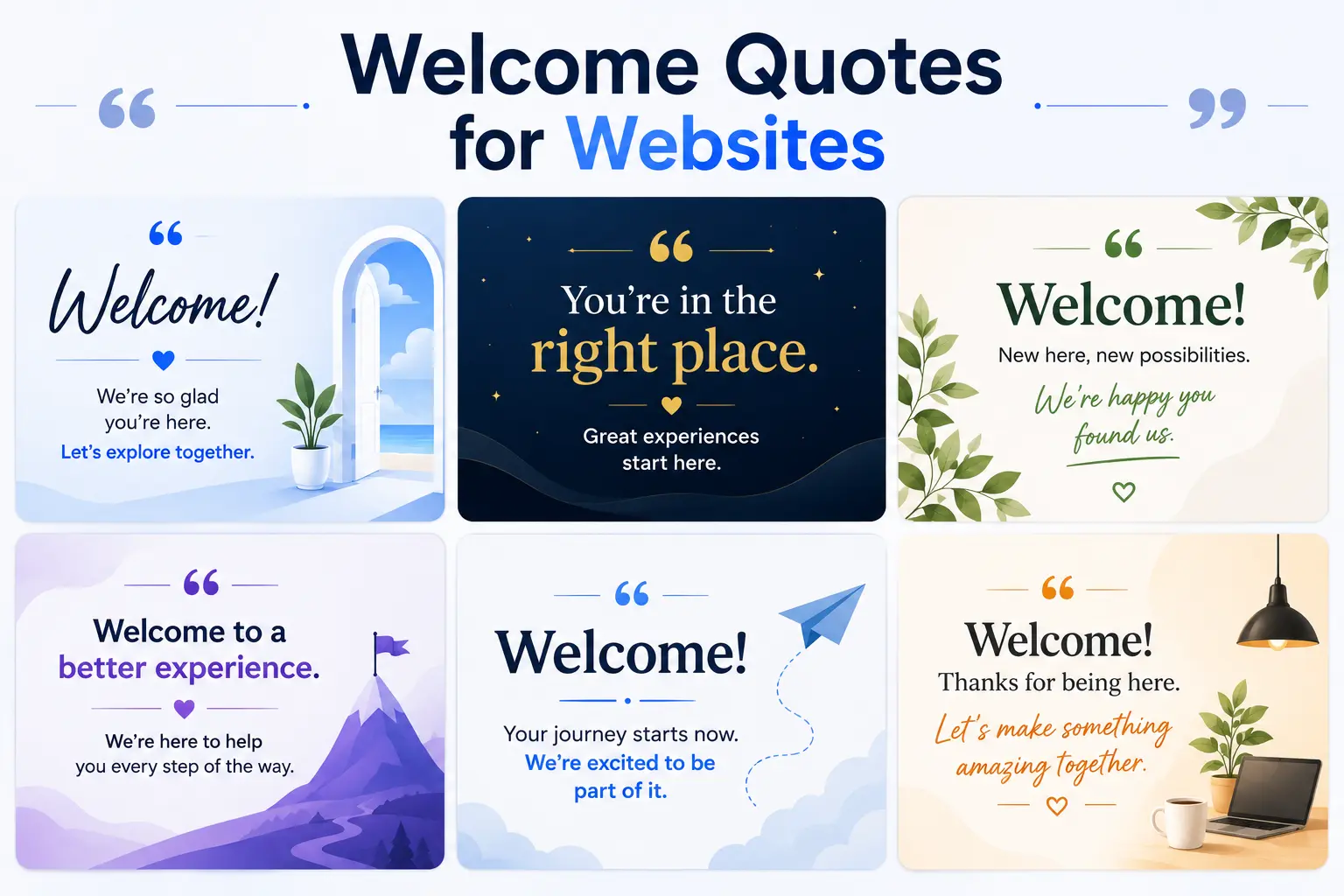
The right welcome message has a profound impact on users beyond one’s expectations. It fulfills several functions simultaneously, which is not always the case with the rest of the page.
First of all, it makes a good impression on the user even before he/she starts reading the main content. Furthermore, a welcome message often tells the users exactly what they can find on the page, sometimes even shorter than an introductory paragraph. In addition, it reassures the users, which is crucial for sites that require personal information, payment data, or any other sensitive information.
Moreover, it tells the users about the image of the brand itself, as the message is constructed in a certain way depending on the company’s characteristics. Another function of a welcome message is to encourage exploration of the site by giving a positive stimulus to proceed. Finally, it helps with maintaining engagement, as well as sustaining attention and stimulating referrals, which in turn build loyalty over time.
How to Write a Good Welcome Message for a Website
- Know your audience. A message written for busy professionals looking for a service reads very differently from one written for hobbyists browsing a community forum. Write for the specific person you expect to land on your page, not for everyone at once.
- Keep it clear. Visitors skim. A welcome message that takes real effort to parse loses its purpose, no matter how clever the wording is.
- Match your brand voice. A law firm and a candle shop shouldn’t sound the same, even if they’re both saying “welcome” in some form.
- Explain the value quickly. Visitors want to know, almost instantly, what they’ll get out of staying on the page.
- Avoid unnecessary words. Trim anything that doesn’t add meaning. Most welcome messages get stronger when they get shorter.
- Use a natural call to action. Not every message needs one, but when it does, keep it conversational rather than pushy.
- Make the message feel human. Visitors respond better to language that sounds like it was written by a person, not assembled from a template.
Short Welcome Quotes for Websites

These work best in a homepage hero section, where space is tight and attention is limited. They’re built to be read in under two seconds, so every word has to earn its place.
- You found us. Now let’s find what you need.
- Good to have you here.
- This is your starting point.
- Glad you stopped by.
- Here’s where it begins.
- You’re exactly where you should be.
- Take a look around.
- Nice to see you.
- Let’s get you settled in.
- This is home base.
- You made it — let’s go.
- First stop: right here.
- We’ve been expecting you.
- Step inside.
- Here’s a good place to start.
- You’re in.
Best placement: Hero section, homepage headline, or a header banner. Best audience: Any visitor arriving for the first time. Recommended tone: Light, direct, low-effort to read. Personalization: Rarely needed — these work best left generic and paired with a more specific subheadline underneath.
Warm and Friendly Welcome Quotes

These are meant to make visitors feel comfortable rather than sold to. They suit sites where trust and connection matter more than a fast conversion — think wellness brands, family-run businesses, or personal blogs.
- We’re happy you’re here, however you found us.
- Come on in — there’s no rush.
- Make yourself comfortable while you look around.
- We built this place with people like you in mind.
- You’re welcome here, plain and simple.
- Take your time. We’ll be here.
- There’s a seat for you at this table.
- Thanks for giving us a few minutes of your day.
- We’re glad this found its way to you.
- It’s nice when the right people find the right place.
- Consider this an open door.
- We hope you feel at ease here.
- You don’t need an invitation. You’re already welcome.
- This space was made to be shared with you.
- However you got here, we’re glad you did.
- Settle in. There’s plenty to see.
Best placement: About page, homepage intro, or a popup that isn’t tied to a discount. Best audience: Visitors who value connection over speed, such as wellness, community, or lifestyle brands. Recommended tone: Gentle, unhurried, personal. Personalization: Helpful — swapping in a name or referencing how the visitor arrived (search, referral, social) makes it feel less templated.
Professional Welcome Messages for Websites
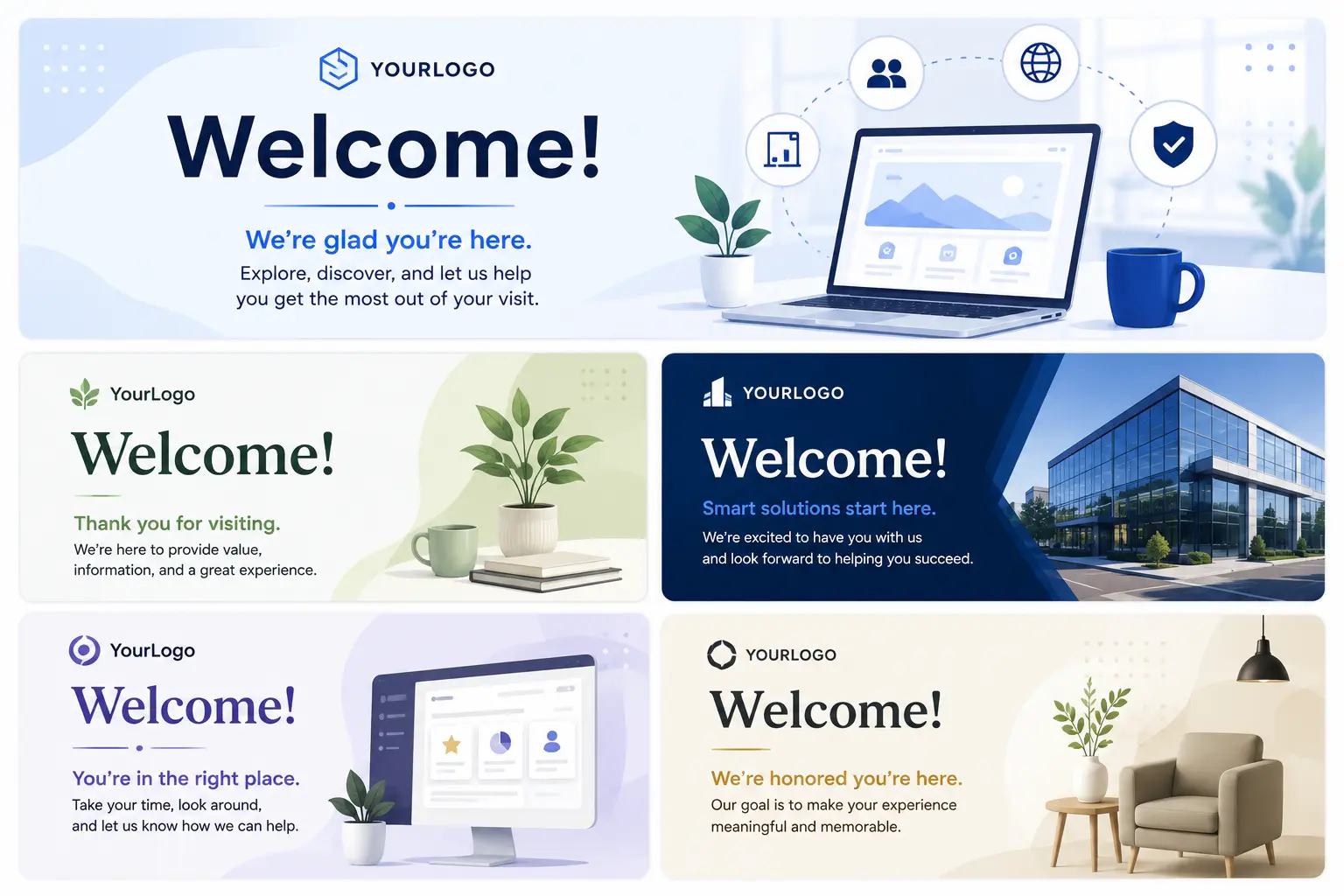
Built for companies, consultants, agencies, and B2B sites where visitors expect competence first and warmth second. These lean confident without sounding stiff.
- Thanks for visiting. Here’s what we do, and how we do it well.
- We work with people who expect results, not promises.
- This is where our clients start every project.
- Our approach is simple: understand the problem, then solve it properly.
- You’ve reached a team that takes the work seriously.
- We put the details here so you don’t have to guess.
- Everything on this site reflects how we actually work.
- We built this page to answer your first questions honestly.
- Our clients come back because the work holds up.
- Here’s a clear look at what we offer and who it’s for.
- We keep things straightforward, starting with this page.
- This is where you’ll find out if we’re the right fit.
- We’d rather show you our work than talk about it.
- Thanks for considering us. Here’s what sets our process apart.
- You’re looking at a team that treats deadlines seriously.
- This page exists to save you a phone call, or start one.
Best placement: Homepage above the fold, services page intro, or the top of an about page. Best audience: B2B buyers, corporate clients, and decision-makers evaluating a vendor. Recommended tone: Confident, measured, low on exclamation points. Personalization: Recommended for industry-specific landing pages — reference the visitor’s sector or role where possible.
Welcome Quotes for Business Websites
These focus on trust, service, and the relationship a business wants to build with the people who visit its site.
- We’ve built our reputation one client at a time — welcome to the next chapter.
- Trust starts with a first conversation. Let’s have it.
- Every business on this list started with a visitor like you.
- We treat your time like it matters, because it does.
- This is where good business relationships begin.
- You’re one click closer to working with people who show up.
- We didn’t get here by cutting corners, and we’re glad you noticed.
- Welcome to a business that still answers the phone.
- Reliability isn’t a tagline here — it’s the whole point.
- You came looking for a business you can count on. Good instinct.
- We built this company on repeat customers, not one-time sales.
- This page is the start of a working relationship, not just a sale.
- Thanks for taking a chance on a business you just met.
- We’ve earned our clients’ trust the slow way — one job at a time.
- Here’s a business that keeps its word.
- You’re welcome to look around, ask questions, and hold us to our claims.
Best placement: Homepage, footer near contact information, or a dedicated “why choose us” section. Best audience: Prospective customers evaluating whether to trust a business with their money or time. Recommended tone: Grounded, honest, quietly confident. Personalization: Works well when tied to a specific industry (contracting, legal, financial, healthcare).
Welcome Messages for Small Business Websites
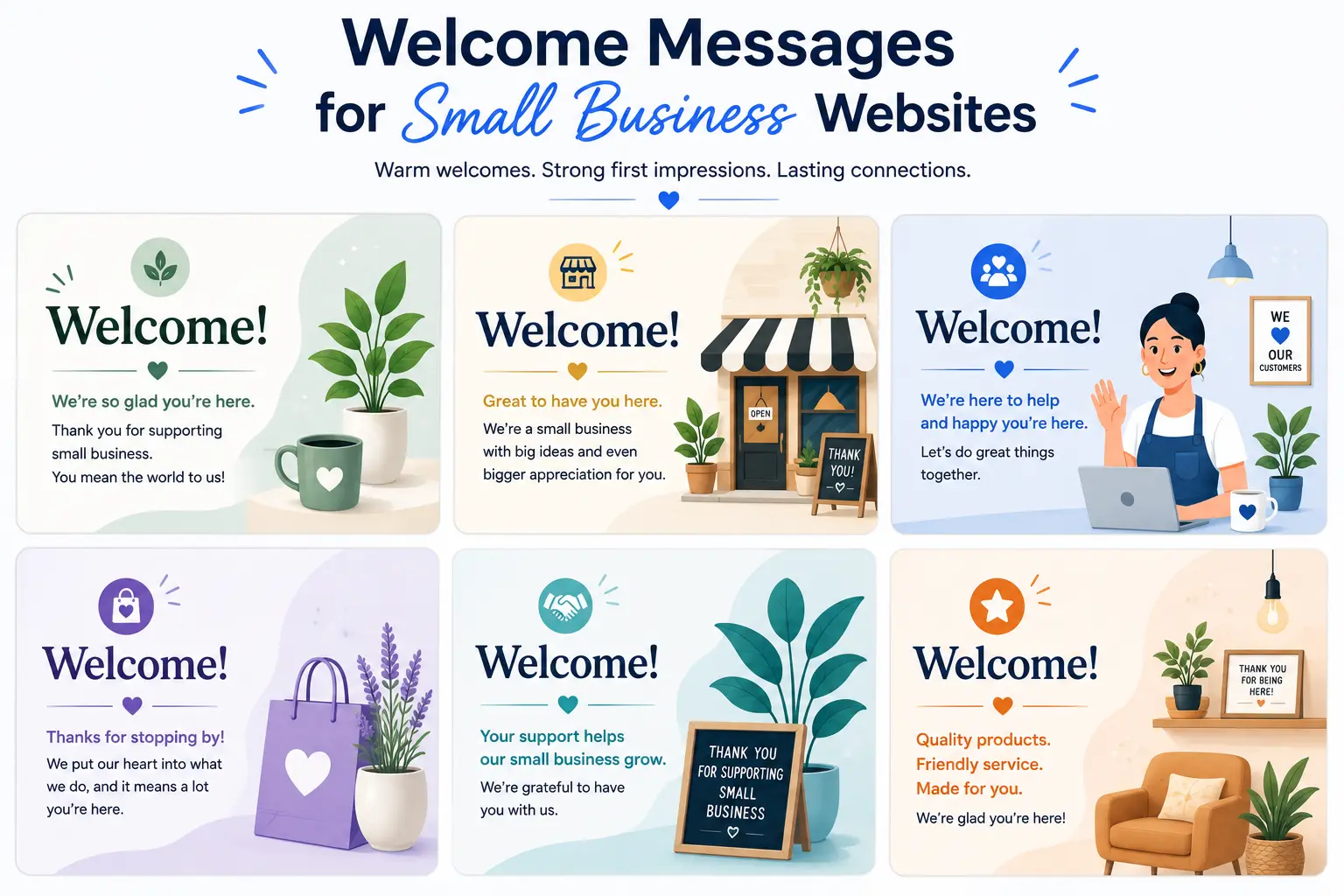
These lean personal and local, since small businesses often compete on relationships rather than scale.
- We’re a small team, and every visitor here matters to us.
- Thanks for supporting a business that’s still run by its founders.
- You won’t get a call center here — just us.
- We started this business in a spare room, and we still remember why.
- Every order gets packed by someone who knows your name eventually.
- This is a small operation with a big appreciation for people like you.
- We answer our own emails, and we’re glad you sent one.
- Small business, big attention to detail.
- You’re supporting real people when you shop here, and we don’t forget that.
- We’re proud of what we’ve built, even if it’s still small.
- Thanks for choosing a business where the owner still knows the inventory.
- This site is run by two people and a lot of coffee.
- We grew this from nothing, and visitors like you are why it’s still growing.
- You’ve found a small business that takes big pride in small details.
- We may be small, but we don’t do anything halfway.
- Every visit here supports a family, not a corporation.
Best placement: About page, homepage intro, or near an owner’s photo or bio. Best audience: Local customers and shoppers who prefer independent businesses over larger chains. Recommended tone: Personal, humble, specific. Personalization: Strongly recommended — mention the owner’s name, the founding story, or the local area.
Welcome Quotes for Online Stores
Not every line here is promotional, since a store that only ever pushes discounts can start to feel like noise. Some quotes lean into discovery and browsing instead of sales.
- Take a look around. Nothing here is trying too hard.
- New arrivals show up here first, before anywhere else.
- We picked every product on this site for a reason.
- Browsing is free, and we mean that in every sense.
- This is where your next favorite thing might be hiding.
- We built this store around things we’d actually buy ourselves.
- Shopping doesn’t have to feel rushed. Take your time here.
- Every item here passed a pickier test than most stores bother with.
- This week’s arrivals are already up. Go take a look.
- We’re not the biggest store, but we’re careful about what we sell.
- Come browse. Buying is optional, but usually happens anyway.
- You’ll find fewer items here, and better ones.
- Welcome to a store that curates instead of stockpiles.
- This is where good taste meets good prices.
- We restock often, so it’s worth checking back.
- Everything here was chosen, not just added to a catalog.
Best placement: Homepage banner, top of the shop page, or a welcome popup for new visitors. Best audience: Shoppers browsing product-based sites, from boutique stores to larger retailers. Recommended tone: Inviting, low-pressure, occasionally playful. Personalization: Effective when tied to season, new arrivals, or a first-time visitor discount.
Welcome Messages for Blogs

These suit personal, lifestyle, travel, tech, food, and educational blogs, where the writer’s voice matters as much as the topic.
- This blog started as notes to myself, and somehow grew into this.
- If you’re here for the writing, you’re in the right place.
- New posts go up regularly, and old ones are worth digging through too.
- This is a small corner of the internet, and you’re welcome in it.
- Everything here comes from actual experience, not guesswork.
- Grab a coffee. Some of these posts run long.
- This blog covers what I know, plus what I’m still figuring out.
- Readers who stick around usually find something worth bookmarking.
- This isn’t a polished magazine. It’s one person’s honest take.
- New here? Start with whatever topic pulled you in.
- This blog exists because I couldn’t find the answers I needed elsewhere.
- Some posts are practical, some are just thoughts. Both are welcome here.
- Thanks for reading something that took longer to write than it takes to read.
- This is where I write down what I wish someone had told me sooner.
- You don’t need to read in order. Jump in wherever looks interesting.
- This blog is proof that a small audience can still be a good one.
Best placement: Blog homepage, top of the about page, or the first paragraph of a welcome post. Best audience: Readers arriving from search, social media, or word of mouth who don’t yet know the writer. Recommended tone: Personal, honest, unpolished in a good way. Personalization: Strongly recommended — reference the blog’s specific niche or the writer’s background.
Welcome Quotes for Personal Websites
Suited to personal brands, portfolios, freelancers, writers, photographers, and designers who need the site to represent them directly.
- This site is a shortcut to everything I’ve made.
- Everything here is mine — the good work and the lessons that shaped it.
- Welcome to a portfolio built from actual projects, not mockups.
- This is where my work speaks before I do.
- I built this site to show, not just tell.
- Take a look at what I’ve made, and reach out if it fits what you need.
- This is a small archive of work I’m proud of.
- You’re looking at years of projects condensed into one page.
- I keep this site updated with whatever I’m working on now.
- This is my work, presented without much filtering.
- Every project here taught me something before I moved to the next.
- Welcome to the place where my work finally has a home.
Best placement: Homepage hero, top of a portfolio page, or an about section. Best audience: Potential clients, collaborators, or employers reviewing someone’s work directly. Recommended tone: Confident, first-person, understated. Personalization: Essential — these should reflect the individual’s actual field and body of work.
Creative and Unique Welcome Quotes
These aim for a slightly different angle without forcing cleverness. They suit brands with a distinct personality who want to stand out from standard greetings.
- Consider this your unofficial invitation.
- You clicked, and now you’re here. Let’s make it worth it.
- This page exists because someone had to say hello first.
- You’re standing at the edge of everything else on this site.
- Somewhere between curiosity and a click, you ended up here.
- This is the part where we introduce ourselves properly.
- You weren’t expected, but you’re not unwelcome either.
- Consider the awkward introductions over. Let’s move on to the good part.
- This site has a personality, and you just met it.
- Whatever brought you here, it worked.
- You’re not just a visitor. You’re the reason this page exists.
- This is less a homepage and more an open door.
- Somebody has to be the first thing you read today — might as well be this.
- You arrived at exactly the right unplanned moment.
- This page has been waiting for someone like you to read it.
- Consider this the handshake before the real conversation.
Best placement: Homepage headline or a hero section paired with distinctive visuals. Best audience: Brands with a defined personality — design studios, creative agencies, indie brands. Recommended tone: Playful but restrained, never forced. Personalization: Optional — these work well as-is but can be adjusted to match a specific brand quirk.
Inspirational Welcome Quotes
Focused on new beginnings, growth, and possibility. These suit coaching sites, educational platforms, wellness brands, and community-driven projects.
- Every new start needs a first page. This is yours.
- Something good usually begins with a small, ordinary click like this one.
- You don’t need to have it figured out to begin here.
- Growth rarely announces itself. It just starts, quietly, like this.
- This is a good place to take the next step, whatever that looks like for you.
- You showed up. That’s usually the hardest part.
- Change starts smaller than people expect — sometimes this small.
- This page won’t change your life, but what you do next might.
- You’re allowed to start over here, as many times as you need to.
- Progress doesn’t care how you arrived, only that you did.
- This is a starting line, not a finish line.
- Whatever brought you here, it’s a reasonable place to begin.
- Some of the best decisions start with an ordinary click like this.
- You don’t need permission to start something new. Consider this a nudge anyway.
- This is where a lot of people decided to try something different.
- Small beginnings are still beginnings.
Best placement: Homepage hero, landing pages for courses or programs, or the top of an about page. Best audience: Visitors considering a change — new skill, new habit, new direction. Recommended tone: Encouraging, grounded, never overly dramatic. Personalization: Works well tied to a specific goal (fitness, career, learning).
Welcome Quotes for Online Communities
Suited to forums, membership groups, learning communities, and professional networks where belonging matters as much as content.
- This community works because people like you show up for it.
- Ask questions here. Someone’s probably wondered the same thing.
- This group grew from people who wanted somewhere real to talk.
- You don’t need to introduce yourself to belong here, but feel free.
- This is a space built by its members, not just for them.
- New here? Read a few threads before you post — or don’t. Either works.
- This community runs on people helping people, nothing fancier than that.
- You’re joining a group that actually reads what you write.
- This space stays useful because people keep contributing to it.
- Whatever brought you to this group, you’ll probably find your people here.
- This community was built slowly, one honest conversation at a time.
- You’re welcome to lurk, post, or just see what this place is about.
Best placement: Community homepage, signup confirmation page, or a pinned welcome post. Best audience: New members joining a forum, group, or membership site. Recommended tone: Inclusive, informal, low on rules and heavy on tone-setting. Personalization: Helpful — reference the community’s specific focus or values.
Welcome Messages for Customers and Clients
Built around appreciation, trust, and the long-term relationship a business wants with the people it serves.
- Thanks for choosing us. We don’t take that lightly.
- Every client here gets treated like a repeat client from day one.
- We built this relationship on more than just a first purchase.
- Thanks for trusting us with something that matters to you.
- Our clients stick around, and we work hard to keep it that way.
- You’re not just another account here. You’re the reason we show up.
- We appreciate clients who ask hard questions. It keeps us sharp.
- Thanks for giving us the chance to prove ourselves.
- Every client relationship starts with a decision like the one you just made.
- We remember our clients, not just their orders.
- Thanks for choosing to work with people who take this seriously.
- Our best work usually comes from clients who trust the process.
- You made a good call trusting us with this. We plan to prove it.
- We’ve built this business around clients who stay, not just ones who buy once.
- Thanks for being here. We don’t assume loyalty — we work for it.
- Every client gets our full attention, starting with this welcome.
Best placement: Client portal, welcome email, onboarding page, or invoice footer. Best audience: New and returning customers or clients who’ve made a purchase or signed a contract. Recommended tone: Sincere, specific, free of generic gratitude phrases. Personalization: Strongly recommended — use the client’s name and reference their specific service or order where possible.
Welcome Quotes for New Visitors
Written for people landing on a site for the first time, with no assumed familiarity with the brand.
- First time here? Here’s a quick look at what this site is about.
- New visitors usually start with this page, so you’re in good company.
- You don’t know us yet, but this page is a fair introduction.
- Welcome — take a minute to look around before you decide anything.
- This is your first look at what we do. We hope it’s a good one.
- New here? No expectations, just an invitation to explore.
- You’ve never been here before, so let’s start with the basics.
- First visits are usually the most honest ones. Take a good look.
- This page exists for people exactly like you — new, curious, unsure what to expect.
- Welcome to your first look at what we’ve built.
- New visitors get the same welcome as everyone else: an honest one.
- You just arrived somewhere new. Here’s what you should know first.
Best placement: Homepage hero, welcome popup, or the first section of a landing page. Best audience: First-time visitors arriving from search engines, ads, or referrals. Recommended tone: Clear, low-pressure, informative. Personalization: Useful when tied to the traffic source (search, ad campaign, referral link).
Funny Welcome Quotes for Websites
Light, broadly usable humor that avoids anything offensive, political, or overly niche.
- You found the website. Achievement unlocked.
- Welcome. We promise this page is more interesting than our loading screen.
- Congratulations on clicking a link and ending up exactly where you intended.
- This website has zero pop-up quizzes about which sandwich you are. You’re welcome.
- We’d offer you a seat, but this is the internet, so just relax where you are.
- Welcome to the only website that won’t ask you to accept cookies twice.
- You’re here, we’re here, let’s make the most of this small coincidence.
- Fair warning: this site is more useful than it is exciting.
- Welcome. No annoying background music, we promise.
- This page took longer to write than it takes to read. We call that dedication.
- You clicked a link expecting a website, and here one is. Wild how that works.
- Welcome to a website with no autoplay video. You’re safe here.
Best placement: Homepage, error pages, or a welcome popup for casual or consumer brands. Best audience: Brands with a lighter tone — consumer apps, hobby sites, casual ecommerce. Recommended tone: Dry, self-aware, never mean-spirited. Personalization: Optional — humor tends to land better when it’s specific to the brand’s quirks rather than generic.
Welcome Quotes With a Call to Action
These nudge visitors toward a next step without sounding like an advertisement in every line.
- Welcome — take a look around, and see what fits.
- You’re here. Might as well see what we’ve got.
- Welcome. If something catches your eye, follow it.
- Take a minute to explore before you decide anything.
- Welcome — feel free to ask questions as you go.
- You made it this far. See what’s next.
- Welcome. If you like what you see, stick around a bit longer.
- Take a look, and reach out if you want more details.
- Welcome — this page is just the start. There’s more to explore.
- You’re in the right place to start looking around.
- Welcome. When you’re ready, we’re one click away.
- Take your time, and let us know if you have questions along the way.
Best placement: Homepage hero, landing page footer, or a welcome popup with a linked next step. Best audience: Any visitor a business wants to move toward browsing, signing up, or contacting them. Recommended tone: Suggestive rather than pushy. Personalization: Recommended — match the call to action to the actual next step available (shop, subscribe, contact, join).
Website-Specific Examples
Ready-to-use lines for common website types, adapted from the categories above.
Business website: “Trust starts with a first conversation. Let’s have it.”
Ecommerce website: “This week’s arrivals are already up. Go take a look.”
Personal blog: “This is a small corner of the internet, and you’re welcome in it.”
Portfolio website: “This site is a shortcut to everything I’ve made.”
SaaS website: “Welcome — take a look around, and see what fits your workflow.”
Agency website: “We work with people who expect results, not promises.”
Consultant website: “This is where you’ll find out if we’re the right fit.”
Restaurant website: “Come as you are. There’s a table, and there’s always something worth trying.”
Travel website: “Every trip worth taking starts with a page like this one.”
Education website: “You don’t need to have it figured out to begin here.”
Nonprofit website: “This work only happens because people like you show up for it.”
Membership website: “This is a space built by its members, not just for them.”
Community website: “Ask questions here. Someone’s probably wondered the same thing.”
Professional service website: “We keep things straightforward, starting with this page.”
Welcome Message vs. Welcome Quote
These terms get used interchangeably, but they aren’t quite the same thing.
A welcome quote is a short, standalone line meant to set a tone. It doesn’t need to explain anything about the website — its job is emotional, not informational.
A welcome message is usually a bit longer and does more explaining. It might combine a greeting with a short description of what the site or business offers.
A homepage headline is the largest, most prominent line on the page. It sometimes doubles as a welcome message, but it’s often more focused on the core offer than on greeting the visitor.
A website greeting is a general term that covers all of the above — any language whose primary job is to acknowledge and welcome the visitor.
Hero section copy refers to everything in that top block of the homepage: headline, subheadline, welcome message, and sometimes a call to action, working together.
Call-to-action text is the specific line that tells a visitor what to do next — “Shop now,” “Get started,” “Join today.” It often follows a welcome message rather than replacing it.
In practice, a strong homepage usually layers these: a short welcome quote or headline, a slightly longer welcome message underneath, and a call to action to close the section.
How to Personalize a Website Welcome Message
A generic welcome message can work, but a personalized one almost always performs better. Personalization can be based on:
Audience. A message written for beginners should sound different from one written for experts in the same field.
Industry. A financial services site and a craft store need different vocabulary and pacing, even for the same basic greeting.
Brand personality. Formal brands should sound formal everywhere, including in the welcome message. Playful brands should carry that same energy through.
Website purpose. A site meant to inform reads differently from one meant to sell or one meant to build community.
Customer expectations. Returning customers can be greeted differently from first-time visitors, especially on a dashboard or account page.
Desired action. If the goal is a newsletter signup, the message should build naturally toward that instead of ending on an unrelated note.
Before and after examples:
Generic: “Welcome to our website.” Personalized (bakery): “Welcome — everything you smell on this page was baked this morning.”
Generic: “Thanks for visiting our store.” Personalized (bookstore): “Thanks for stopping by. New releases are on the front table, as always.”
Generic: “Welcome to our community.” Personalized (running club): “Welcome — if you’ve ever finished a run and immediately started planning the next one, you’ll fit right in here.”
Generic: “Welcome to our services.” Personalized (accounting firm): “Welcome. If tax season gives you a headache, that’s exactly why we’re here.”
Website Welcome Message Formulas
These formulas give you a starting structure. Adjust the wording to match your brand voice.
Welcome + Audience + Value “Welcome, [audience] — here’s [value] you won’t find elsewhere.” Example: “Welcome, small business owners — here’s bookkeeping software that doesn’t require an accounting degree.”
Welcome + Problem + Solution “Welcome. If you’re dealing with [problem], you’ve landed somewhere that solves it.” Example: “Welcome. If your inbox feels unmanageable, you’ve landed somewhere that fixes that.”
Welcome + Brand Promise “Welcome to [brand] — we [core promise], every time.” Example: “Welcome to Fielder & Co — we answer the phone ourselves, every time.”
Welcome + Community + Invitation “Welcome to a community built around [shared interest]. Come see where you fit in.” Example: “Welcome to a community built around slow travel. Come see where you fit in.”
Welcome + Benefit + Call to Action “Welcome — [benefit] is just a click away. [Action].” Example: “Welcome — a clearer schedule is just a click away. Start your free trial.”
Common Mistakes
Being too generic. A welcome message that could belong to any website usually doesn’t help any website.
Writing too much. Most welcome messages lose visitors after the second sentence. Say less.
Using corporate jargon. Words like “synergy,” “leverage,” or “solutions-driven” tend to distance visitors rather than reassure them.
Trying too hard to sound clever. Forced wordplay is usually more noticeable than the intended cleverness.
Failing to explain the website’s purpose. A warm greeting that never says what the site actually does leaves visitors guessing.
Using an aggressive sales pitch. A welcome message isn’t the place for hard selling. Save that for later in the page.
Ignoring the target audience. A message written for everyone often connects with no one in particular.
Using a welcome message that doesn’t match the brand. A playful line on a serious legal site (or a stiff one on a playful brand) creates friction before visitors even reach the content.
FAQ
What is a good welcome message for a website?
A good welcome message is short, matches the brand’s tone, and gives visitors a quick sense of what the site offers. It usually runs one or two sentences.
How do I welcome visitors to my website?
Place a short welcome line in your homepage hero section, keep it specific to your brand and audience, and pair it with a clear next step if relevant.
What should I write on my homepage?
A clear headline, a short welcome or value statement underneath it, and a call to action that points visitors toward the next logical step.
How do you write a professional welcome message?
Keep the tone measured, avoid exclamation points, focus on what the business does well, and skip overly casual language.
What is a short welcome message?
A short welcome message is usually under 15 words and designed to be read in a few seconds, often used in a hero section or popup.
How do I welcome new customers?
Thank them specifically for their purchase or signup, use their name if possible, and briefly point them toward what to expect next.
What makes a good website welcome message?
Clarity, brand alignment, and brevity. The best welcome messages sound like a person talking, not a template filling in blanks.
Should a website have a welcome message?
Most websites benefit from one, even if it’s just a short line in the hero section. It sets tone before visitors read anything else.
Where should I put a welcome message on my website?
Most commonly in the homepage hero section, but also useful on about pages, signup pages, dashboards, and welcome emails.
How long should a website welcome message be?
Anywhere from a few words to two sentences. Longer messages tend to lose visitors before they finish reading.
How do I make my website greeting more personal?
Reference your audience directly, mention specifics about your brand or story, and avoid language generic enough to fit any other website.
What is the difference between a welcome quote and a welcome message?
A welcome quote is a short, tone-setting line with little explanation. A welcome message is usually longer and includes some description of what the site or business offers.
You May Also Like
 Business Quotes
110 Mindset Business Quotes to Build Wealth, Resilience, and Long-Term Growth
 Business Quotes
70 Inspiring Business Quotes to Fuel Your Success
 Business Quotes
250+ Restaurant Welcome Message Examples for Every Occasion, Menu, Sign, and Screen
 Money Quotes
50+ Money Heist Quotes: Iconic Lines from La Casa de Papel That Define Resistance and Rebellion
 Business Quotes
120+ Customer Welcome Messages for Ecommerce, WhatsApp, and Live Chat
 Business Quotes
350+ Welcome Messages for Customers, Clients & Guests (2026 Guide With Templates You Can Steal)
 Business Quotes
100+ Professional Welcome Back Messages for Coworkers: Warm Words for the Return to Work
 Business Quotes
150+ Best Ways to Say “Good Luck in Your Future Endeavors”
 Family and Relationships