What Does 67 Mean in Slang? A 2026 Guide to the Viral “Six-Seven” Craze
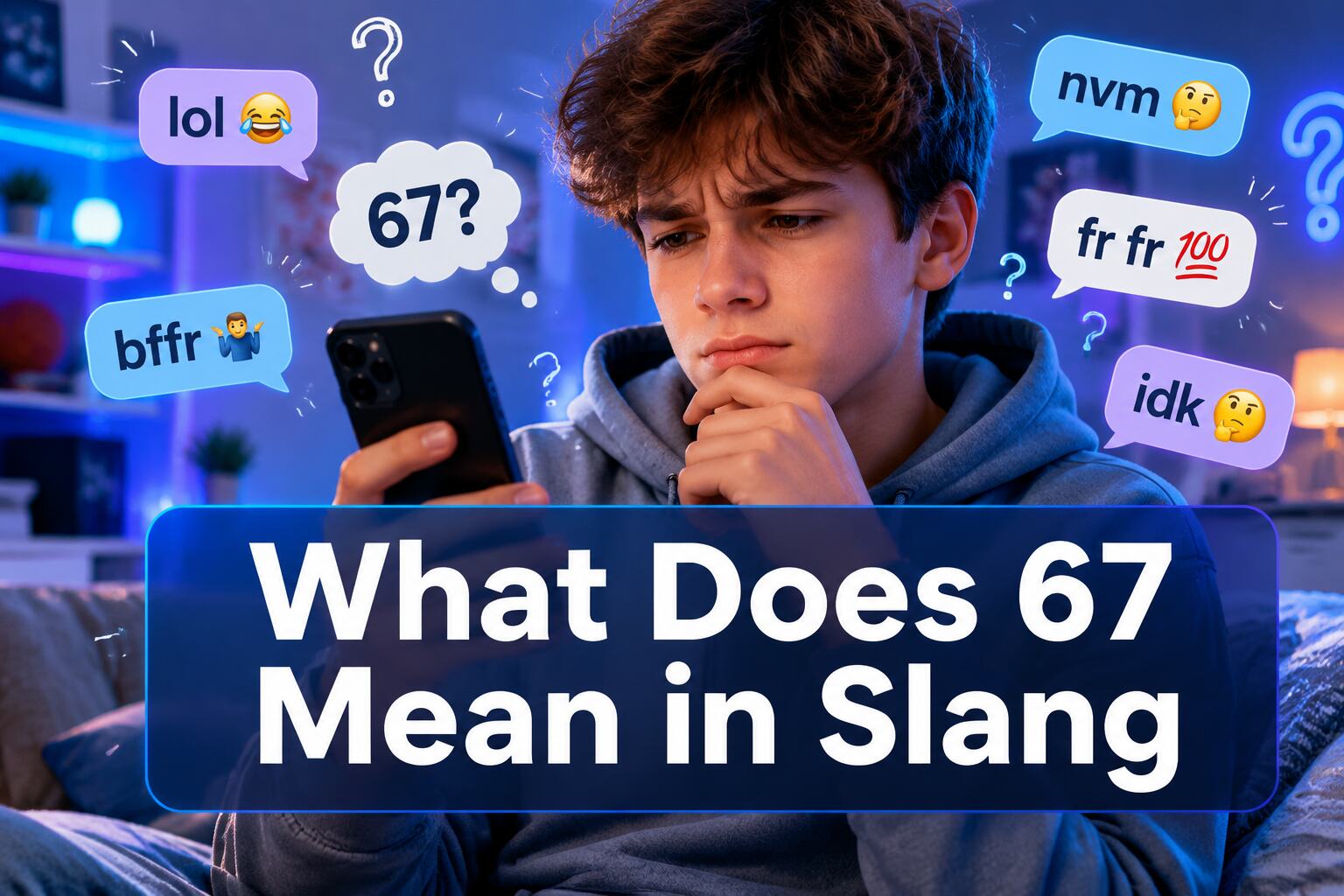
If you’ve spent any time around a kid under the age of fifteen in the last year, you’ve probably heard it: someone asks an innocuous question — what time is it, how tall are you, what’s for dinner — and back comes the answer, singsong and immediate, “six seven,” usually paired with two open palms bobbing up and down like a scale that can’t decide which side is heavier. It sounds like a typo when you see it written as “67.” It sounds like a phone number when someone says it out loud for the first time. It is, in practice, one of the most inescapable pieces of slang to come out of 2025, and depending on who you ask, it means everything, nothing, or something in between.
That’s not a dodge. “67” is genuinely one of those rare slang terms that resists a tidy definition, and a lot of the confusion around it comes from people trying to find a hidden meaning that was never really there. It didn’t start as code for anything. It started as a rap lyric, got attached to a very tall basketball player, was cemented by a kid shouting it into a camera at a youth game, and then spread through classrooms and group chats with the speed of something that spreads specifically because it’s a little bit annoying and a lot of fun to say. There’s also an older, unrelated “67” — the name of a UK drill collective from South London — and the two get mixed up online, but they’re not the same thing, and if a teenager in your life is yelling “six seven” at the dinner table, it’s almost certainly the meme, not the music group.
This guide breaks down where “six seven” actually came from, what it’s supposed to mean (spoiler: not much), how it shows up on TikTok and in texts, and why it’s driven so many teachers and parents up the wall.
Where “67” Actually Comes From
The trail starts with a song, not a hashtag. In December 2024, rapper Skrilla released a track called “Doot Doot,” built around a repeated, almost tossed-off lyric: “six-seven, I just bipped right on the highway.” The song didn’t blow up right away. It gained traction slowly on TikTok through late 2024 and early 2025, mostly as background audio, before it was officially released as a single that February.
The real ignition came from basketball. Editors started pairing the “six-seven” hook with clips of NBA player LaMelo Ball, who happens to stand exactly 6 feet 7 inches tall, and the combination clicked in the way internet jokes sometimes do for no fully explainable reason. From there, the meme picked up two key mascots. Taylen “TK” Kinney, a point guard in the Overtime Elite league, became known for answering interview questions with the phrase, half-joke and half-bit. And in March 2025, a boy named Maverick Trevillian was filmed yelling “six seven” at a youth basketball game with the now-signature two-handed gesture — a clip that went viral and turned him into “the 67 kid,” the meme’s unofficial face.
By the fall of 2025, it had escaped basketball entirely. Teachers were making TikToks about students shouting it during math class. NFL players were doing the hand gesture in touchdown celebrations. In-N-Out reportedly pulled the number 67 from its order-calling system in some locations because crowds of teenagers had started gathering to cheer whenever it was called. Politicians made jokes about it on the floor of the House. Dictionary.com eventually named “67” its word of the year, while more or less admitting in the same breath that the word doesn’t really mean anything at all.
So What Does It Actually Mean?
This is the part that trips people up, because they assume a phrase this popular must be shorthand for something specific — a place, a feeling, an inside joke with a clear punchline. It mostly isn’t. Ask ten kids what “six seven” means and you’ll get ten different, only-half-serious answers: that it’s about being “so-so” or in-between (which lines up with the wavering hand gesture), that it’s a nod to LaMelo Ball’s height, that it references a street or a jersey number, or simply that it means nothing on purpose and that’s the entire joke.
The most honest answer is the one linguists and dictionary editors have landed on: it’s a nonsensical, all-purpose interjection that took off because it’s catchy and endlessly flexible, not because it encodes a specific idea. It works as a reaction, a punchline, a call-and-response, or a way to derail a conversation, and it can be dropped into almost any sentence that has room for a number, a pause, or an excuse to do the hand motion. That flexibility is exactly why it spread as fast as it did — there’s no barrier to using it “correctly,” because there isn’t really a correct way to use it.
How Kids Actually Use It
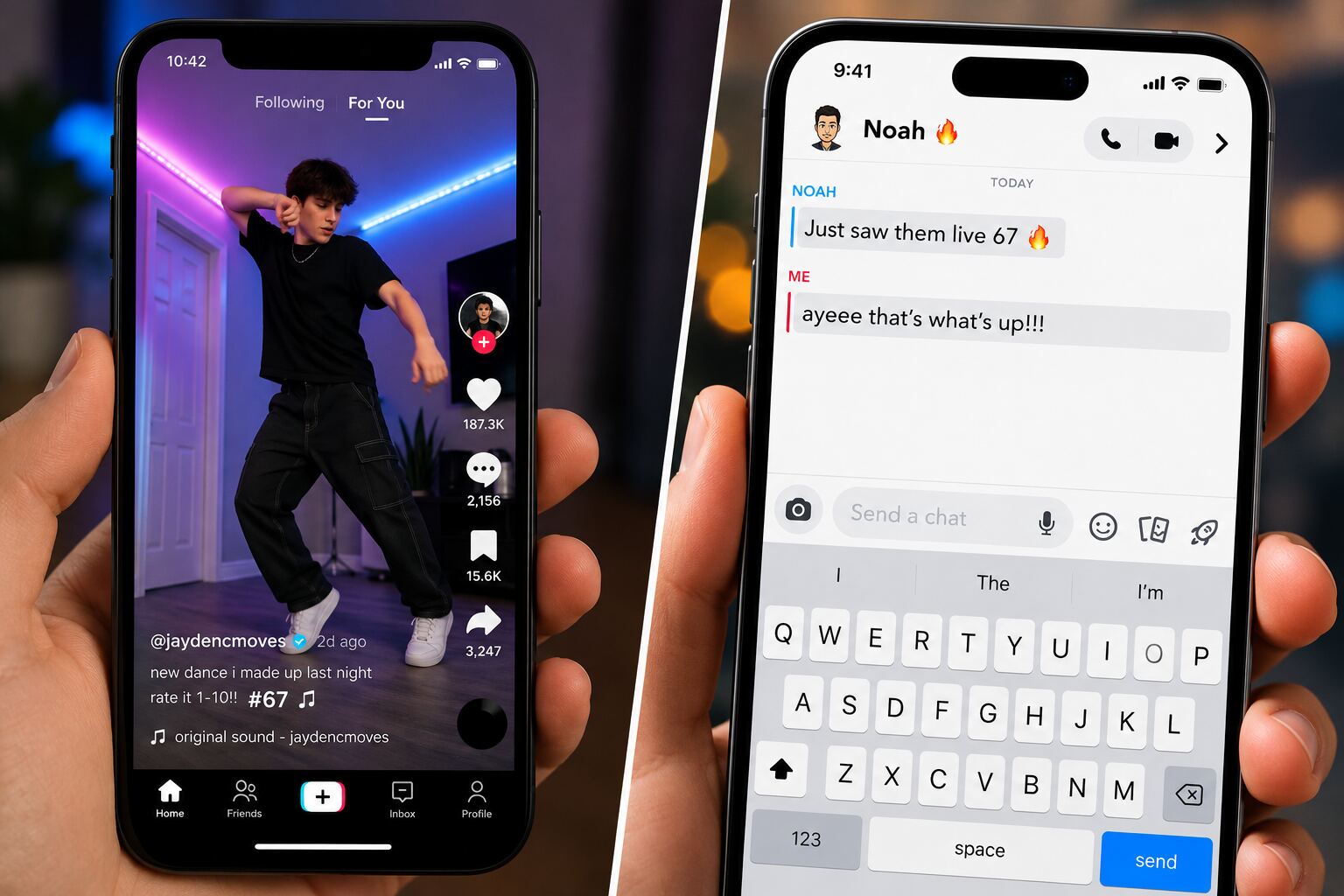
In practice, “67” rarely shows up as the number sixty-seven. It’s spoken and typed as “six seven,” almost always as two separate beats, and it’s often accompanied by that wavering, palms-up-and-down gesture. A teacher says “six,” the class yells back “seven.” A friend asks what time it is, and instead of an answer they get “six seven” and a laugh. A kid bombs a test and captions the photo of their grade “67/100, couldn’t have said it better myself.”
On TikTok and Instagram, it shows up as a caption, a comment, or the entire point of a video — someone reacting to any number, phrase, or coincidence involving six or seven with exaggerated enthusiasm. In texts, it functions less like a word and more like an emoji: a low-effort, high-recognition way to signal “I saw this and it’s funny” without needing to explain why. If you’re trying to parse it for hidden meaning the way you might with an older acronym like “IDK” or “TTYL,” you’re approaching it the wrong way. It’s less a message and more a shared reflex.
Is “67” Something Parents Should Worry About?
Not really, and that’s probably the most reassuring thing to say about it. Unlike some viral slang, “six seven” isn’t tied to anything explicit, harmful, or coded — it’s not a euphemism for drugs, self-harm, or anything else that shows up on the lists parents are usually right to be cautious about. Its origin in a rap song is about as edgy as it gets, and even that context has mostly fallen away; most kids using the phrase today have never heard “Doot Doot” and couldn’t tell you who Skrilla is.
What actually seems to bother adults about “67” isn’t danger, it’s noise. Teachers describe it as one of the most disruptive slang trends they’ve dealt with, not because it’s inappropriate but because it’s loud, constant, and used as a way to get a rise out of a room. If a kid in your life won’t stop saying it, the honest move is to treat it the way you’d treat any other passing meme — mildly annoying, entirely harmless, and very likely gone in a matter of months, replaced by whatever number comes next.
A Quick Note on the Other “67”
Worth flagging separately: there is a real UK drill collective called 67, formed in the mid-2010s in Brixton Hill, South London, whose members helped define the sound of the genre. If you come across “67” in the context of UK drill music, a British commenter, or a discussion of the group’s discography, that’s a different reference entirely — a shoutout to the artists, not the meme. The two uses share nothing but a number, and context usually makes it obvious which one you’re looking at: basketball, classrooms, and hand gestures point to the meme; music credits and UK drill playlists point to the group.
Frequently Asked Questions (FAQ)
What does “67” mean in slang? Mostly nothing specific. It’s a viral, nonsensical phrase — said as “six seven” — that took off from a 2024 Skrilla song and a basketball meme, and it’s used as an all-purpose reaction or punchline rather than a coded message.
Why do kids say “six seven” instead of “67”? Because that’s how it’s meant to be spoken — two distinct beats, often paired with a hand gesture — even when it’s written out as the number 67 in texts or captions.
Is “67” the same as the UK drill group 67? No. The UK drill collective 67 is an unrelated, older reference from South London’s music scene. The viral “six seven” meme comes from a 2024 rap lyric and a basketball-adjacent meme, and it’s the version almost anyone under 15 means today.
Is “67” appropriate for kids to say? Yes. It isn’t tied to anything explicit or dangerous — it’s closer to a nonsense catchphrase than a coded term, even if it drives teachers and parents up the wall.
Where did the “67 kid” come from? He’s Maverick Trevillian, a boy filmed shouting “six seven” with the signature hand gesture at a youth basketball game in March 2025. The clip went viral and made him the face of the meme.
Does “67” have anything to do with LaMelo Ball? Indirectly. Early viral edits paired the “six seven” lyric with clips of Ball, who stands 6 feet 7 inches tall, which helped cement the phrase’s association with basketball.
Is “67” still popular in 2026? It’s cooled from its late-2025 peak, when it was named Dictionary.com’s word of the year, but it’s still widely recognized and used, especially among Gen Alpha kids and younger teens.
You May Also Like
 Fun Questions
1500+ This or That Questions for 2026: From Silly Choices to Deep Conversations
 Fun Questions
What Does WSG Mean in Text? How to Respond to WSG in Messages and Social Media
 Fun Questions
350+ Truth or Dare Questions: Play Classic Party Games With Your Friends
 Fun Questions
250+ This or That Questions for Back to School: The Ultimate Icebreaker Guide for Teachers and Students
 Fun Questions
157+ This or That Questions for Cousins: Fun Conversations
 Fun Questions
155+ This or That Questions for Black People: A Complete Cultural Connection Guide
 Fun Questions
What Does GNG Mean in Text? Meaning Slang, Examples, and Real Usage
 Fun Questions
What Does SYBAU Mean? SYBAU Slang Meaning, Origin & Examples
 Fun Questions