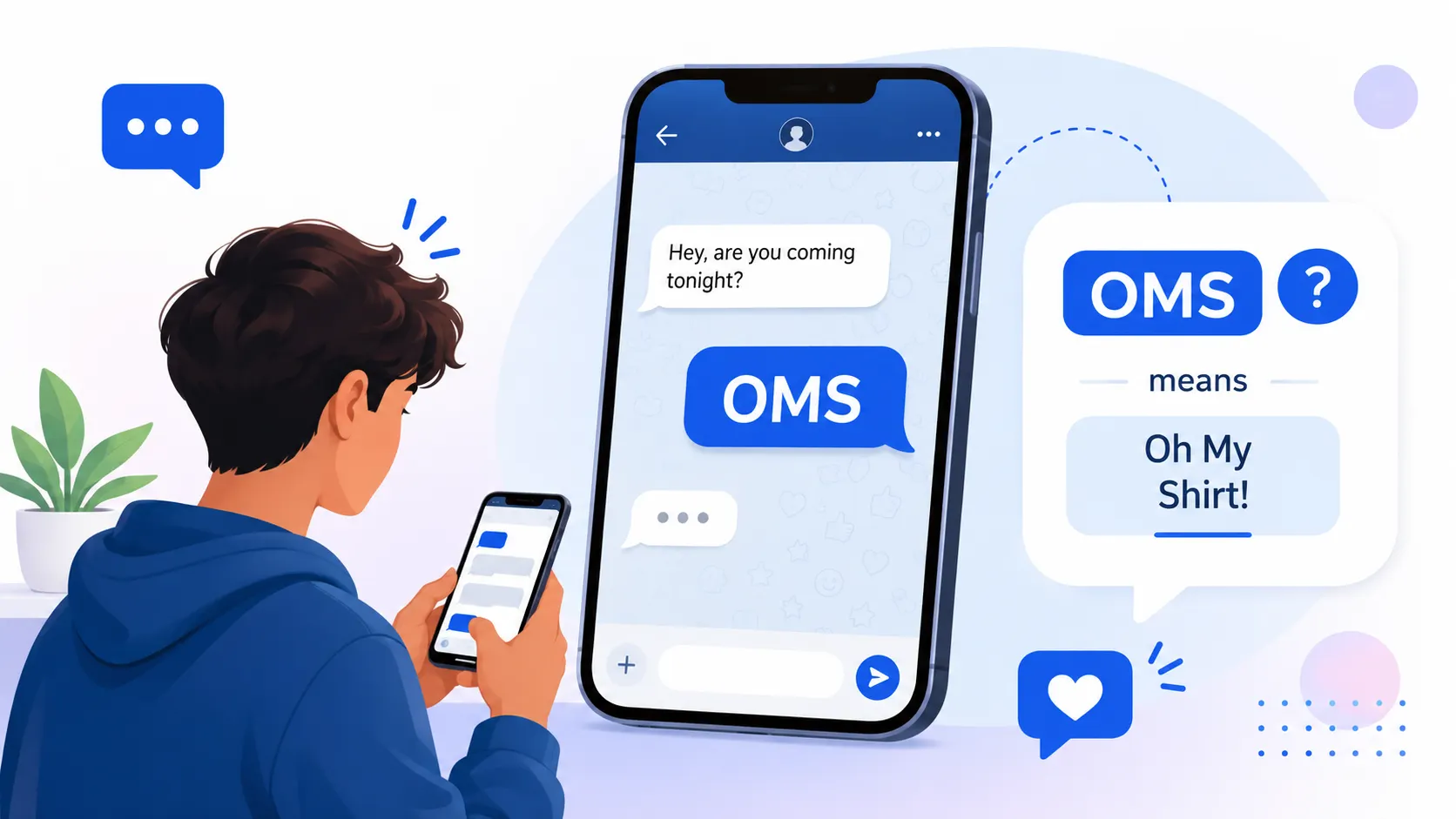
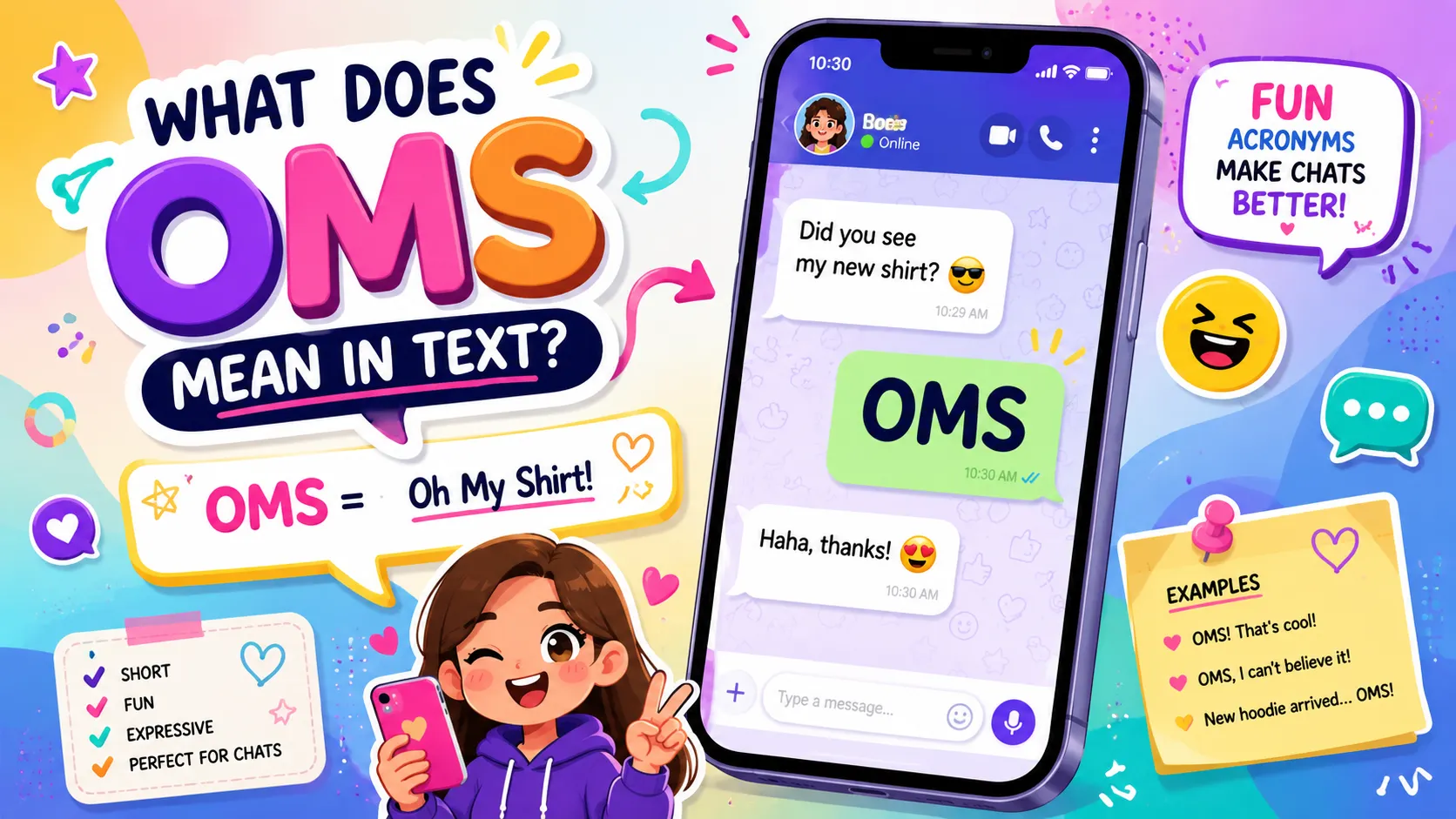
What Does OMS Mean in Text? A Practitioner’s Guide to One of Gen Z’s Most Confusing Acronyms
If you’ve spent any time scrolling through TikTok comments, Snapchat replies, or a group chat with anyone under 25, you’ve probably seen “oms” tossed around with the casual confidence of a word everyone is supposed to know. The problem is that what does OMS mean in text doesn’t have a single clean answer — and that’s precisely why it trips people up, especially parents monitoring their kids’ phones, English learners trying to keep up, and even fluent slang users who assume the meaning is obvious.
After tracking how OMS is actually used across platforms, and comparing it to how dictionary sites define it, I’ve noticed a gap: most articles give you one definition and move on. Real usage is messier. OMS shifts meaning depending on the platform, the age of the sender, the tone of the conversation, and even whether it appears at the start or end of a sentence. This guide unpacks all of that, so you’re not just memorizing an acronym — you’re reading it correctly in the wild, the same way you’d want a clear breakdown of what “imsg” means in text or what “otw” means in text before dropping it into a conversation yourself.
Key Takeaways
- OMS most commonly means “Oh My Sh*t” in casual Gen Z texting, functioning as a stronger version of OMG.
- A cleaner secondary meaning is “Oh My Stars,” popular on Snapchat and among users who avoid profanity.
- Context is everything — OMS can also mean “Order Management System” in business texts or “On My Soul” as an oath of sincerity in certain online communities.
- It’s almost always an exclamation, expressing shock, disbelief, excitement, or exasperation.
- It’s not interchangeable with OMG in every situation — the emotional intensity is usually higher, and it reads younger.
- Misreading OMS as a typo for “OMG” is the most common mistake older users make.
What OMS Actually Means in Text
The dominant meaning in 2026 is “Oh My Sh*t” — an intensified version of “Oh My God” or “Oh My Gosh.” It’s used the same way, but with more emotional weight. Someone doesn’t just type OMS because a package arrived on time; they type it because their friend just told them something genuinely shocking, hilarious, or overwhelming.
The second widely accepted meaning is “Oh My Stars,” which serves as the family-friendly alternative. This version gained traction largely on Snapchat, where it’s been suggested as a softer expression, and among users who want the same expressive punch without the profanity.
Beyond those two, OMS carries several situational meanings that matter depending on where you encounter it:
| Meaning | Typical Context | Register |
|---|---|---|
| Oh My Sh*t | Gen Z texting, TikTok, Discord | Casual, profane |
| Oh My Stars | Snapchat, family chats, softer online spaces | Casual, clean |
| On My Soul | Used as an oath (“oms I didn’t do it”) | Emphatic, streetwise |
| Order Management System | Business, e-commerce, logistics texts | Professional |
| Organizational Management System | Corporate or HR communication | Professional |
The professional meanings are important to flag because “OMS” is genuinely common in e-commerce and retail operations. If a colleague texts you “the OMS is down,” they are not having an emotional moment — they’re telling you the order management platform crashed.
Why the Meaning Shifts: A Closer Look
Here’s something most explainer articles miss: OMS is a context-dependent acronym, not a fixed-meaning one. That distinction matters because it changes how you should interpret it.
Fixed-meaning acronyms like LOL, BRB, or IDK mean roughly the same thing regardless of who sends them. OMS behaves differently. It functions almost like a homograph — same letters, different meanings depending on the environment, much like other bits of internet slang that carry more than one meaning depending on where you spot them. The signals that tell you which meaning is intended include:
- The platform. Snapchat leans toward “Oh My Stars.” TikTok comments lean toward “Oh My Sh*t.” Slack in a retail company leans toward the operations system.
- The sender’s age. Teenagers overwhelmingly use the profane version. Users over 30 more often mean the clean version — if they use it at all.
- Punctuation and capitalization. “OMS!!!” is almost always an exclamation. “The OMS” almost always refers to a system.
- Surrounding words. “oms I can’t” is emotional. “oms integration deadline” is technical.
Once you internalize this, you stop guessing and start reading OMS the way experienced texters do — as a variable, not a constant.
When OMS Matters (and When It Doesn’t)
When It Matters
Understanding OMS matters most when:
- Parents are trying to gauge conversations their kids are having. Seeing “oms” doesn’t automatically mean something concerning, but knowing the profane meaning helps you read tone accurately.
- English learners are trying to sound natural in casual online communication. Using OMS correctly signals fluency in current internet culture, the same fluency that helps when you’re trying to start a conversation with someone new.
- Content creators are writing captions and want to match how their audience actually speaks.
- Customer service reps or moderators need to interpret user messages accurately, especially when tone matters.
When It Doesn’t Matter
Honestly, in most professional communication, OMS shouldn’t appear at all in its slang form. If you’re writing a work email, a LinkedIn post, or any communication where clarity outweighs personality, skip it. The ambiguity alone is a reason to avoid it — half your readers might interpret it differently than you intended.
This is a point most listicles skip: just because you know a slang term doesn’t mean you should use it. OMS in particular carries a Gen Z texture that can feel forced coming from anyone trying to sound younger than they are.
OMS vs. OMG vs. OMFG: A Comparison
One of the most common questions I see is whether OMS is just a substitute for OMG. It isn’t — not exactly.
| Acronym | Literal Meaning | Emotional Intensity | Typical User | Register |
|---|---|---|---|---|
| OMG | Oh My God / Gosh | Mild to moderate | All ages | Broadly acceptable |
| OMS | Oh My Sh*t / Stars | Moderate to strong | Mostly Gen Z | Casual, sometimes profane |
| OMFG | Oh My F*cking God | Strong | Adults, gamers | Profane, informal |
| OMGGG | (Extended OMG) | High excitement | Teens, young adults | Playful, casual |
Notice that OMS occupies a specific middle ground: more intense than OMG, less aggressive than OMFG, and coded as younger than either. That positioning is why it caught on — it filled a gap in expressive range.
What Practitioners Notice About OMS
A few patterns worth flagging that you won’t find in most explainer content:
1. OMS is a “reaction acronym,” not a conversational one. Unlike acronyms such as IMO or TBH that shape how a sentence is delivered, OMS is almost always a standalone reaction. It rarely appears mid-sentence. This is a strong tell — if you see OMS embedded inside a sentence with a subject and verb, it’s more likely to mean “On My Soul” (an oath) or a technical system reference.
2. It’s part of a broader trend of “softened profanity acronyms.” OMS sits in the same family as WTH (what the heck), FFS (for f*ck’s sake), and STFU. These acronyms let users express strong emotion while retaining plausible deniability about the exact word used. That flexibility is a feature, not a bug — it’s why they spread.
3. The clean meaning is losing ground. Based on how the term appears across platforms in 2026, “Oh My Stars” is increasingly a minority interpretation, kept alive mostly by users who initially learned OMS from platform-suggested phrases. If you’re guessing without context, “Oh My Sh*t” is the safer bet.
4. OMS has a lifespan. Slang acronyms follow predictable arcs: emergence, adoption, mainstream saturation, and cringe phase. OMS is currently in the saturation phase — widely used but not yet mocked. Expect it to feel dated within a few years, the way “YOLO” and “on fleek” now do. This isn’t a criticism; it’s just how internet language works.
Common Mistakes People Make With OMS
- Assuming it’s a typo for OMG. It isn’t. The S is intentional.
- Using it in professional contexts. Even the clean meaning reads as too casual for work.
- Overusing it. Slang loses power quickly when repeated. If every third message contains OMS, it stops functioning as an exclamation.
- Confusing it with the business acronym. Context usually clarifies this, but if you’re in an e-commerce or retail environment, be aware that OMS almost certainly refers to an Order Management System.
- Reading it as aggressive. In most Gen Z usage, OMS is playful or startled, not hostile — even when it stands for the profane version.
- Trying to use it if you’re outside the target demographic. This isn’t gatekeeping; it’s just that slang comes with generational credibility. Using it self-consciously often reads as trying too hard.
Practical Recommendations
If you’re a parent or educator trying to understand what your teenager is saying, treat OMS as a shock/excitement marker roughly equivalent to “Oh my God.” The specific word behind the S is less important than the emotional signal. Focus on the surrounding conversation, not the acronym itself — and if you’re looking for ways to keep that conversation going, a few conversation topics to talk about with friends and family can help bridge the generational gap.
If you’re learning English or new to internet slang, understand OMS passively before using it actively. Recognize it when you see it, but don’t force it into your own messages until you’ve seen it used enough times to feel the rhythm. Building a wider bank of things to talk about in everyday conversation will help slang like this click faster.
If you work in content, marketing, or community management, be careful about using OMS in brand copy. It can feel authentic when a creator uses it, but performative when a brand does. The line between the two is thin and unforgiving.
If you’re a regular user who just wants to know whether to use it: the safest rule is to use it sparingly, in reactions to genuinely surprising or funny things, and only in casual contexts with people who already text in that register — the kind of casual back-and-forth you’d find while meeting new people and making friends online.
Frequently Asked Questions
What does OMS mean in text from a girl?
The meaning doesn’t change based on the sender’s gender. It still most commonly means “Oh My Sh*t” or “Oh My Stars” depending on context. Any interpretation beyond that is reading in signals that aren’t actually there.
Is OMS the same as OMG?
Not exactly. OMS is a variant with stronger emotional intensity and a distinctly younger, more casual register. They’re related but not interchangeable.
What does OMS mean on Snapchat?
On Snapchat specifically, OMS has often been associated with “Oh My Stars” due to platform-suggested phrases, but users increasingly use it with the profane meaning as well. Read the context of the conversation.
What does OMS mean on TikTok?
On TikTok, OMS almost always means “Oh My Sh*t” — used in comments to express shock, awe, or amusement at a video.
Can OMS mean “On My Soul”?
Yes, in certain contexts — especially when used as an oath or emphatic promise (“oms I didn’t say that”). This meaning is more common in specific online communities and streetwise slang.
Is OMS appropriate for work?
No. Even the clean interpretation is too informal for professional contexts, and the ambiguity itself is a reason to avoid it in workplace communication — unless you’re referring to an Order Management System.
Is OMS a bad word?
The letters themselves aren’t offensive, but one common meaning is a profane expression. Whether it counts as a “bad word” depends on which interpretation applies.
How do you respond when someone texts OMS?
Treat it as an exclamation and respond to whatever prompted the reaction. It usually signals surprise, excitement, or disbelief, so match that energy or acknowledge what they’re reacting to — it’s a good moment to lean on a few fun conversation topics to talk about with anyone if you want to keep the exchange going.
Conclusion
So, what does OMS mean in text? The short answer is that it usually means “Oh My Sh*t” or “Oh My Stars,” functioning as an intensified version of OMG. The longer, more useful answer is that OMS is context-dependent — its meaning shifts based on platform, sender, tone, and even sentence structure. Reading it correctly requires paying attention to those cues, not just memorizing a definition.
The broader lesson is worth holding onto: internet slang isn’t a dictionary. It’s a living dialect that reflects who’s using it, where, and why. Acronyms like OMS carry generational identity, emotional texture, and social signaling that a straight definition can’t capture. Understanding that — not just the letters — is what lets you read digital communication the way it’s actually meant to be read, whether you’re deciphering a text, prepping some small talk questions for a first hangout, or just trying to find interesting issues to talk about with the next generation.
You May Also Like
 Fun Questions
1500+ This or That Questions for 2026: From Silly Choices to Deep Conversations
 Fun Questions
What Does WSG Mean in Text? How to Respond to WSG in Messages and Social Media
 Fun Questions
350+ Truth or Dare Questions: Play Classic Party Games With Your Friends
 Fun Questions
250+ This or That Questions for Back to School: The Ultimate Icebreaker Guide for Teachers and Students
 Fun Questions
157+ This or That Questions for Cousins: Fun Conversations
 Fun Questions
155+ This or That Questions for Black People: A Complete Cultural Connection Guide
 Fun Questions
What Does GNG Mean in Text? Meaning Slang, Examples, and Real Usage
 Fun Questions
What Does SYBAU Mean? SYBAU Slang Meaning, Origin & Examples
 Fun Questions