Red Flags and Green Flags in a Relationship: Meaning, Examples, and How to Spot Them Early
You know that feeling when someone you’re dating says something and your stomach quietly tightens? Or the opposite, that soft exhale you didn’t know you were holding when your partner just… gets it? Those small moments are exactly what this conversation is about.
We throw around “red flag” and “green flag” so casually now that they’ve almost lost their weight. TikTok, group chats, first dates, late-night therapy sessions. But under the memes and the trends, these little signals are doing something important. They’re your nervous system trying to tell you something before your brain has words for it. Learning to listen to them, without spiraling into paranoia or ignoring them out of hope, might be one of the kindest things you ever do for yourself.
So let’s talk honestly. Not from a checklist. From what people actually live through, what therapists see in their offices every week, and what most of us have felt at one point or another but couldn’t quite name.
Featured Snippet
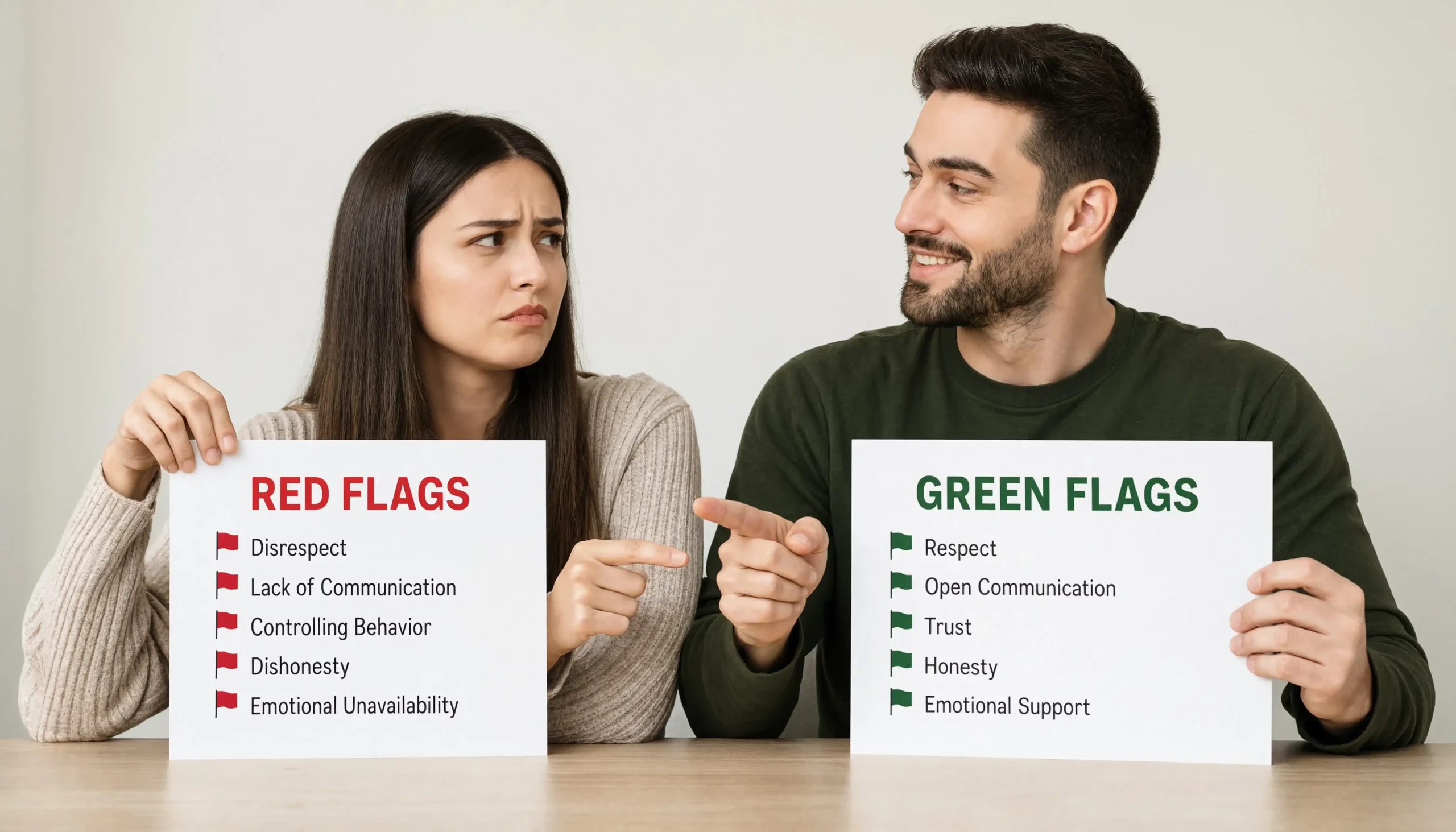
A red flag in a relationship is a behavior or pattern that signals possible harm, disrespect, or long-term incompatibility, like controlling behavior, dishonesty, or emotional manipulation. A green flag is the opposite. It is a sign of a healthy, safe partner, such as honest communication, steady respect, emotional support, and consistency between what someone says and what they do.
What Is a Red Flag and Green Flag?
A red flag isn’t just something you don’t like about someone. Everyone has habits. He leaves cabinet doors open. She talks through the best part of the movie. That’s not a warning sign. That’s being human.
A red flag is a pattern. Something that keeps showing up and quietly chips away at your safety, your voice, or your sense of self. If you’re honest with yourself, it’s usually the thing you’ve been trying not to see.
A green flag is the quieter cousin. It doesn’t ask for attention. It just shows up, again and again, until one day you notice you feel calmer around this person than you have in years. Green flags are what emotional safety looks like in ordinary moments, not just grand gestures.
Here’s the truth most articles skip. A green flag isn’t the absence of red flags. Someone can be charming and thoughtful and still have patterns you’ll need to reckon with. And someone can annoy you regularly and still be one of the safest people you’ll ever love. The goal isn’t a perfect person. It’s a real one whose patterns you can live with, grow with, and trust.
Red Flag and Green Flag Meaning in a Relationship
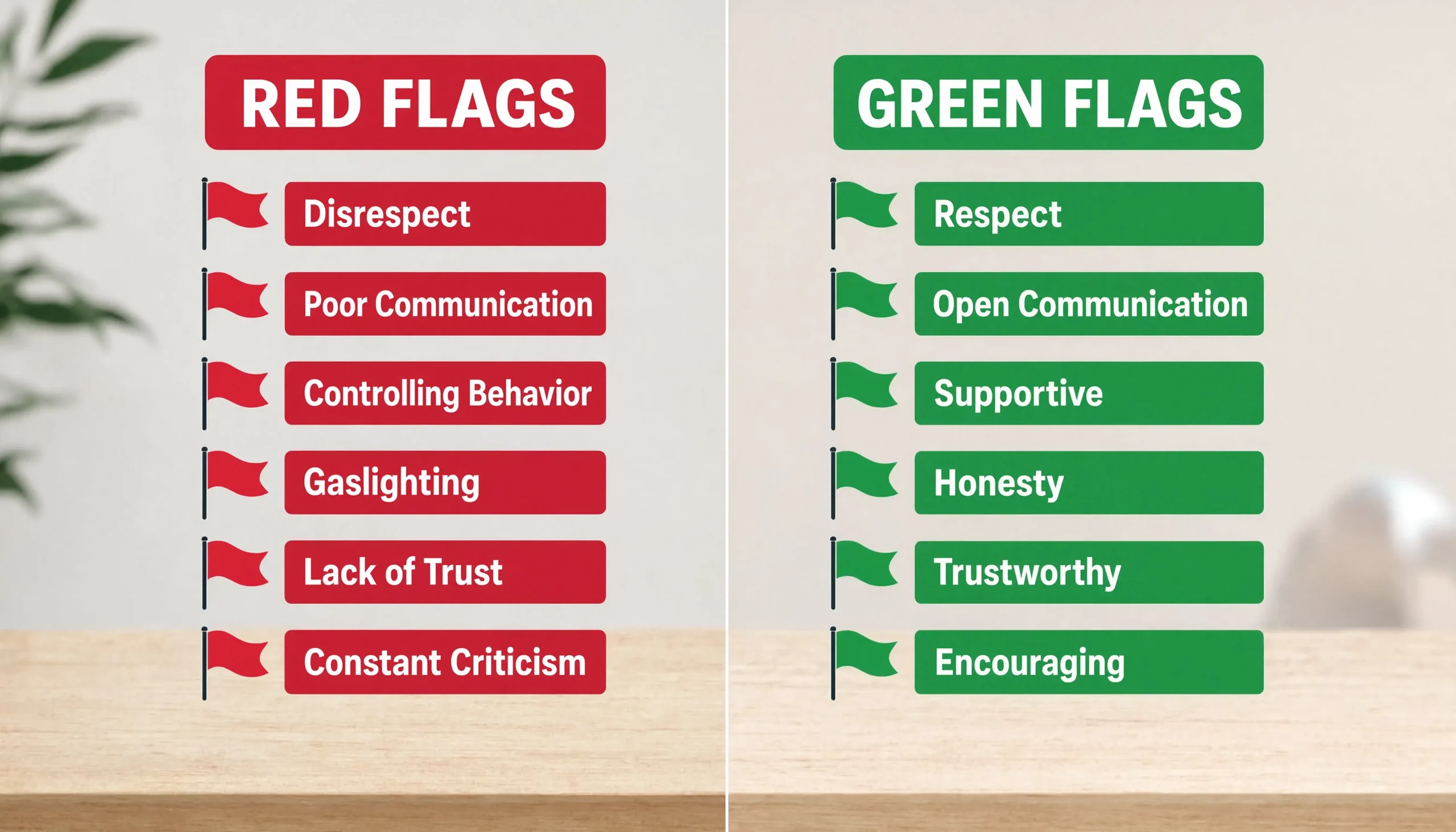
If you want the simplest way to think about it, try this. A red flag is a signal that says, “slow down and pay attention here.” A green flag is a signal that says, “you can breathe here.”
Red flags often show up around control, honesty, and how someone handles being told no. Green flags often show up around respect, repair after conflict, and whether words and actions match over time.
Neither one is about how you feel on the very best day. It’s about how you feel on an ordinary Tuesday. Are you edited around this person, softer, smaller, quieter? Or are you more yourself?
That question alone tells you more than any list can.
Why We Call Them Red and Green Flags
The language comes from warning flags on beaches and race tracks. Red means stop and pay attention. Green means the way is clear. In relationships, the terms got popular because they gave us a shorthand for something a lot of people, especially those healing from past hurt, struggled to name for years.
People used to say, “he seemed off, but I couldn’t explain why.” Now they say, “that was a red flag.” It’s imperfect language, but it gave a whole generation permission to trust their gut without apologizing for it. If you grew up in a home where your instincts were called overreactions, this vocabulary can feel like finally being handed a pair of glasses.
If any of that hits close, you might see yourself in what’s covered in signs you grew up in a toxic family. The way we learn to read danger and safety usually starts long before our first relationship.
Red Flags vs Green Flags: Quick Comparison
| Area | Red Flag | Green Flag |
|---|---|---|
| Communication | Silent treatment, stonewalling, or yelling | Talks even when it’s hard, stays calm |
| Trust | Constant lying, half-truths, hidden accounts | Honest even when it costs them something |
| Boundaries | Pushes past your no, sulks when told no | Respects your no without punishing you |
| Conflict | Blames you, throws old wounds like weapons | Repairs after arguments, apologizes cleanly |
| Emotional safety | You edit yourself around them | You feel more yourself, not less |
| Consistency | Hot then cold, sweet then cruel | Steady mood, steady effort |
| Values | Says one thing, does another | Words and actions match over time |
| Growth | Defensive, refuses feedback | Open to therapy, self-reflection, change |
20 Red Flags in a Relationship (With Examples)
These are patterns, not one-time slip-ups. A bad day is not a red flag. A bad pattern is.
1. Love Bombing
The first two weeks feel like a movie. Flowers at work. Long good-morning texts. “I’ve never felt this way about anyone.” Then, right around the point you start trusting it, the temperature drops.
That whiplash isn’t romance. It’s love bombing, and it’s often how manipulative partners establish control before you’ve had time to see them clearly.
What it sounds like: “You’re my soulmate. I already know.” On day four.
2. Controlling Behavior
It starts small. He doesn’t like that shirt on you. She wants to know why it took you 40 minutes to answer. Then it grows. Who you see, what you wear, where you go, what you post.
Control disguises itself as love. It says, “I just care about you.” Real care doesn’t need you smaller to feel safe.
3. Constant Jealousy
Jealousy in tiny doses is human. Chronic jealousy is a warning. If a coworker’s name makes them tense, if your old friendships suddenly become “sus,” if you find yourself justifying who you had lunch with, something is off.
If you’re on the receiving end of that energy from friends or family too, how to deal with jealous people can help you understand the pattern.
4. Gaslighting
You bring up something they said. They say it never happened. You get an apology, then five minutes later they’re arguing you never deserved one. You start doubting your own memory.
Gaslighting is one of the clearest signs of emotional manipulation, and it’s exhausting because it makes you feel crazy for noticing the truth.
5. The Silent Treatment
Instead of talking through conflict, they shut down for hours or days. No explanation. Just cold air. You end up apologizing for things you didn’t do, just to end the freeze.
Stonewalling like this trains you to avoid honest conversations, which is the opposite of what a real relationship needs.
6. Disrespect Toward People Who Can’t Do Anything for Them
Watch how they treat the waiter. The Uber driver. The receptionist. Their mother when they think you’re not listening. The way someone treats people with no power over them tells you exactly who they’ll be to you in five years.
7. Frequent Lying, Even About Small Things
Not big betrayals. Small ones. Where they were. Who they were with. Whether they actually paid that bill. Small lies signal a bigger issue: they’re more committed to their image than to you.
8. Everything Is Your Fault
Somehow, every argument circles back to something wrong with you. You’re too sensitive. You’re too much. You’re not enough. You start editing yourself just to keep the peace, and one day you realize you don’t recognize yourself anymore.
9. They Don’t Respect Your No
You say you don’t want to talk about something. They keep pushing. You say you’re tired. They guilt you. Your no becomes a starting point for negotiation instead of a full sentence.
Healthy partners don’t punish you for having limits.
10. Isolating You From Loved Ones
It sounds like concern at first. “Your friend isn’t good for you.” “Your sister is jealous of us.” Slowly, you’re spending less time with the people who know you best.
Isolation is one of the earliest and most dangerous patterns in emotionally abusive relationships. If this feels familiar, some of what’s shared in signs of toxic behavior in relationships may put words to what you’ve been feeling.
11. Explosive Anger
Doors slam. Voices rise fast. You find yourself scanning their mood the moment you walk in. Living around unpredictable anger keeps your body in low-grade fear, even when things are quiet.
12. Never Taking Accountability
They apologize, but it always includes a “but.” “I’m sorry I yelled, but you knew I was stressed.” “I’m sorry I lied, but you would have overreacted.” A real apology doesn’t hand the blame back to you.
13. Comparing You to Their Ex
Whether it’s flattering or critical, comparisons are a bad sign. It means their ex is still occupying emotional space that belongs to you.
14. Using Your Vulnerabilities Against You
You told them your deepest fear in a soft moment. Six weeks later, in an argument, they throw it at you. That’s not a fight. That’s a weapon.
15. Moving Too Fast
Moving in after a month. “I love you” on the third date. Talking about kids before you’ve met their friends. Fast doesn’t automatically mean wrong, but it often means one of you is running from something rather than building toward something.
16. Financial Control or Secrecy
Hidden accounts, secret spending, refusing to share money conversations, or the opposite, wanting full control over yours. Money patterns reveal trust patterns.
17. Contempt
Eye rolls. Sarcasm. Sighing when you speak. Contempt is one of the strongest predictors of relationship breakdown in psychology research. It’s not just rudeness. It’s disrespect wearing a costume.
18. Refusing to Meet Your People
After six months, you still haven’t met their friends or family. There’s always a reason. Something about it just doesn’t add up. Someone hiding you from their world is telling you something about your place in it.
19. They Only Show Up When They Need Something
Weeks of distance, then suddenly warmth when they want a favor, a ride, a place to stay. Consistency isn’t there. If that sounds familiar, you may recognize yourself in they only remember you when they need you quotes.
20. You Feel Worse Than You Did Before You Met Them
This one’s not scientific. It doesn’t need to be. If you were more confident, more social, more you before this relationship, that’s data.
The right person doesn’t shrink you. If you’re doubting yourself constantly, working on how to stop being insecure in a relationship can help you tell the difference between your own anxiety and a real warning.
20 Green Flags in a Relationship (With Examples)
Green flags are subtle. They rarely make it into rom-coms. But they’re what long, happy relationships are actually built on.
1. They Ask How You’re Really Doing
Not just “how was your day,” but the follow-up question. The pause. The eye contact. You feel heard, not managed.
2. Their Words Match Their Actions
They say they’ll call. They call. They say they’ve got you. They show up. Trust is built in these tiny, unglamorous moments over months.
3. They Handle Conflict Without Losing Themselves
Disagreements happen. What matters is what happens next. Do they name their feelings without blame? Do they come back after taking space? A partner who can repair is worth a hundred who can’t.
4. They Respect Your No
Even when it disappoints them. Even when they wish you’d said yes. A no doesn’t turn into a debate.
5. They’re Kind to People They Don’t Have to Be Kind To
Servers, strangers, the person who took the last parking spot. Kindness that shows up when no one’s watching is real character.
6. They Root for Your Growth
Your promotion doesn’t threaten them. Your new hobby doesn’t annoy them. Your friendships don’t compete with them. They want you to become more of yourself, not less.
7. They Own Their Mistakes
A clean apology. No “but.” No blame. Just, “I did that, I’m sorry, I’ll do it differently.” It sounds simple. It’s rarer than you think.
8. They Talk About the Future Without Pressure
You know where they see this going, and you know because they’ve told you. Not through hints. Not through pressure. Through honest conversations you both feel safe having.
9. Their Ex Isn’t a Villain
They can talk about past relationships without contempt or obsession. That usually means they’ve done some reflection instead of just collecting characters for a story where they’re always the victim.
10. They’re Emotionally Available
They cry when something is sad. They celebrate when something is joyful. They don’t perform stoicism to protect an image. Emotional availability isn’t weakness. It’s a gift.
11. They Ask About Your Family Without Judging Them
Even complicated ones. They understand your history shaped you, and they don’t hold your family’s mistakes against you.
12. Silence Feels Safe
Not every moment needs filling. You can sit on the couch with your books and feel completely at ease. That’s a rare, underrated form of intimacy.
13. They Encourage Your Friendships
They know you having a life outside the relationship makes the relationship stronger, not weaker.
14. They Believe You
When you say something hurt, they don’t argue you out of your feeling. They sit with it. Being believed by your partner is one of the most healing experiences an adult can have.
15. They Take Care of Themselves
Not perfectly, but on purpose. They sleep, they see friends, they try to grow. You’re not their entire emotional support system, which means you get to be their partner, not their therapist.
16. Money Conversations Feel Boring, Not Explosive
Bills, plans, goals, worries. All discussed openly. Nothing hidden. Financial transparency is one of the strongest quiet green flags in long-term relationships.
17. They Enjoy the Small Version of You
The one with bad hair, no makeup, tired eyes, stressed voice. They don’t need the highlight reel version. They like the Tuesday-night version.
18. They Say Please and Thank You
To you. To the delivery driver. To their own family. Small manners reveal deep respect.
19. They Take Feedback Without Falling Apart
You can say, “hey, that hurt,” and they can hear it without spiraling into shame or defensiveness. That’s emotional maturity, and it’s the ground floor of everything.
20. You Feel Like Yourself With Them
Louder, softer, funnier, quieter, whichever version of you is true. You’re not performing. You’re just there. That’s the biggest green flag of them all.
Some of this shows up beautifully in healthy relationship tips for couples, especially the quiet everyday habits that hold love together.
Early Red Flags to Watch for When Dating Someone New

The first few weeks are strange. Everyone’s on their best behavior. But even inside the sparkle, small things speak loudly if you listen.
Someone who talks constantly about themselves and rarely asks about you. Someone whose stories about every ex end the same way, with them being the victim. Someone who pushes physical or emotional intimacy faster than feels natural. Someone who gets weirdly upset over small delays in responses. Someone whose kindness switches off the moment they don’t get what they want.
None of these are proof of anything. They’re invitations to slow down. Give it time. The mask comes off around week eight for most people. Let it.
Subtle Green Flags Most People Miss
Not every green flag looks like a Pinterest quote. Some are so small they feel like nothing.
They text you when they arrive home safely because they know you worry. They remember which coffee you order. They ask before venting instead of dumping. They apologize without being prompted when they realize they were short with you. They’re happy for your wins even when their own week has been hard.
These are the flags long-term couples remember when they look back. Not the vacations. Not the anniversaries. The Tuesday nothings that added up to everything.
Red Flags vs Yellow Flags vs Beige Flags
Not every warning is the same size.
A red flag is a hard stop. Something that threatens your safety, your dignity, or your sense of self.
A yellow flag is a slow-down sign. It might not mean the relationship is wrong, but it means something needs a conversation. Maybe he doesn’t communicate well when stressed. Maybe she gets guarded around your family. These are workable, but they’re worth naming out loud.
A beige flag is the newest addition to the vocabulary. It’s a quirk. A weird preference. Something odd but harmless. He orders the same meal every single time. She narrates what the dog is thinking. Beige flags aren’t warnings. They’re just texture. They’re what makes someone specifically them.
Knowing the difference protects you from two mistakes: leaving over beige flags, and staying through red ones.
Red Flags for Specific Situations
Dating a narcissist: grandiosity in the early days, contempt for anyone who criticizes them, sudden coldness the moment you disappoint them. If any of this feels familiar, signs of narcissist traits in women may give you language for what you’ve been sensing.
Recovering from abuse: anyone who dismisses your past, rushes your healing, or makes you feel guilty for having triggers. You deserve someone who moves at your pace.
Long-distance relationships: inconsistent contact, vague answers about their day, resistance to video calls, no plan for closing the distance.
After marriage or living together: contempt in daily interactions, refusal to do therapy when things are struggling, keeping secrets about money or time.
Green Flags After a Toxic Relationship
If you’re coming out of something hard, your radar might feel scrambled. That’s normal. When you’ve been trained to accept crumbs, a full meal can feel suspicious.
Green flags after a toxic relationship often look like this. Someone who is calm when you’re anxious. Someone who doesn’t take your triggers personally. Someone who says, “take your time,” and means it. Someone who is boring in the best way, meaning no drama, no chaos, no walking on eggshells.
Healing your ability to receive that kind of love is its own journey. Resources like healing from betrayal trauma can help if the wound is still fresh.
How to Respond to Red Flags
First, pause. Don’t confront in a spike of emotion. Don’t post about it. Don’t screenshot it to your group chat as your first move.
Sit with what you noticed. Write it down if that helps. Ask yourself: is this a pattern, or a bad night? If it’s a pattern, name it out loud to yourself before you name it to them.
When you talk to them, lead with your experience, not their character. “I felt small in that conversation” lands very differently than “you’re controlling.” Watch how they respond. That response is more data than the original behavior. A partner who can hear hard feedback, sit with it, and change is very different from one who turns it back on you.
If safety is a concern, please reach out to trusted resources like The Hotline (1-800-799-7233) in the United States. You deserve support, not just self-help articles. And if you’re carrying pain from past relationships, emotional hurt sad quotes can be a soft place to land while you figure out your next step.
How to Nurture Green Flags
Green flags aren’t a finish line. They’re a garden. They need tending.
Notice them out loud. “I love that you always ask how my day was.” Small appreciation feeds healthy behavior. Return the energy. Green flags aren’t a spectator sport. Be one for them too.
Protect the peace you’ve built. Don’t invite chaos in through jealousy, comparison, or old patterns. And when you disagree, use it as practice, not war. Every conflict handled well is a deposit in the emotional bank account.
Some of the best patterns come from things you’d never expect, like the everyday habits in how to communicate better in relationships.
Reflection Questions
Sit with these before you sit with your partner.
- Am I more myself in this relationship, or less?
- Do my nervous system and my mind agree about this person, or are they at war?
- When I imagine another five years of exactly this, do I feel warm or tired?
- Do I feel safe telling them things they might not want to hear?
- Have their patterns gotten better, worse, or stayed the same since we started?
- What would I tell my best friend if they described this exact relationship to me?
FAQ
What is a red flag in a relationship?
A red flag is a pattern of behavior that signals possible harm, disrespect, or long-term incompatibility. Common examples include controlling behavior, lying, gaslighting, and refusing to respect your boundaries.
What is a green flag in a relationship?
A green flag is a sign of emotional health and safety in a partner. Examples include honest communication, respect for your no, clean apologies, and consistency between words and actions.
Is jealousy a red flag or a green flag?
Small human moments of jealousy are normal. Chronic jealousy that leads to controlling behavior, checking your phone, or accusing you without evidence is a red flag.
What are the biggest red flags in a new relationship?
Love bombing, moving too fast, disrespect toward strangers, contempt for their exes, and pushing past your limits early are some of the clearest early warnings.
What are subtle green flags most people miss?
Consistency, kindness to strangers, calm apologies, respect for your friendships, and the ability to sit in silence together comfortably.
Are green flags the opposite of red flags?
Mostly, yes. Red flags erode trust and safety. Green flags build them.
How many red flags are too many?
There’s no magic number. One serious red flag around safety, honesty, or respect is enough to pause and reflect. Repeated patterns of smaller ones add up quickly.
Can red flags turn into green flags over time?
People can change, especially with therapy, self-awareness, and effort. But change should be visible in behavior, not just promises. Watch what they do, not what they say they’ll do.
Is controlling behavior always a red flag?
Yes. Control disguises itself as love or concern, but it consistently makes the other person smaller. Healthy love expands you, not shrinks you.
What are green flags after a toxic relationship?
Calmness, consistency, patience with your healing, respect for your pace, and someone who feels boring in the best possible way. No chaos. No walking on eggshells.
Should I leave at the first red flag?
Not always. Some red flags are worth a real conversation first. Others, especially involving safety or repeated dishonesty, are worth leaving over. Trust your gut and, when possible, trust the people who love you and can see clearly when you can’t.
How do I build more green flags in my own relationship?
Practice honesty, apologize cleanly, listen without preparing your rebuttal, respect your partner’s no, and stay curious about who they’re becoming. Green flags grow when both people water them.
A Final Thought
Here’s the thing nobody tells you. You will miss some red flags. You will overlook some green ones. You will love the wrong person for a season, and you will almost lose the right person because they didn’t come with fireworks. That’s not failure. That’s being human, learning as you go.
What matters is that you keep listening. To your gut. To your body. To the small tightening in your chest and the small exhale on the couch. Your instincts are not overreactions. They’re not paranoia. They’re information you spent your whole life gathering, and they deserve a seat at the table when you decide who to love.
You are allowed to want peace. You are allowed to want a partner who is kind on ordinary days, not just special ones. You are allowed to walk away from what shrinks you, and you are allowed to stay and grow with what steadies you.
That’s the whole map. Red means pause. Green means breathe. And you get to decide, over and over, which direction to walk.
You May Also Like
 Personal Motivation Quotes
137+ Disappointment Life Failure Quotes: Real Words to Help You Through Tough Times
 Personal Motivation Quotes
147+ Disappointment Some Things Never Change Quotes: Finding Wisdom in Life’s Unchanging Patterns
 Toxic Relationships
150+ Disappointment Relationship Priority Quotes: When You’re Not Their First Choice
 Family and Relationships
170+ Upset Sad Status for Husband: Real Messages When You’re Hurting
 Rejection Quotes
150+ People Use You Quotes: Feeling Used, Taken for Granted & Learning Your Worth
 Toxic Relationships
175+ Disappointment Quotes When People Cancel Plans
 Toxic Relationships
Sexual Harassment by Non-Employees: What Every Workplace Must Know
 Toxic Relationships
How to Prevent Sexual Harassment in School
 Healthy Relationships