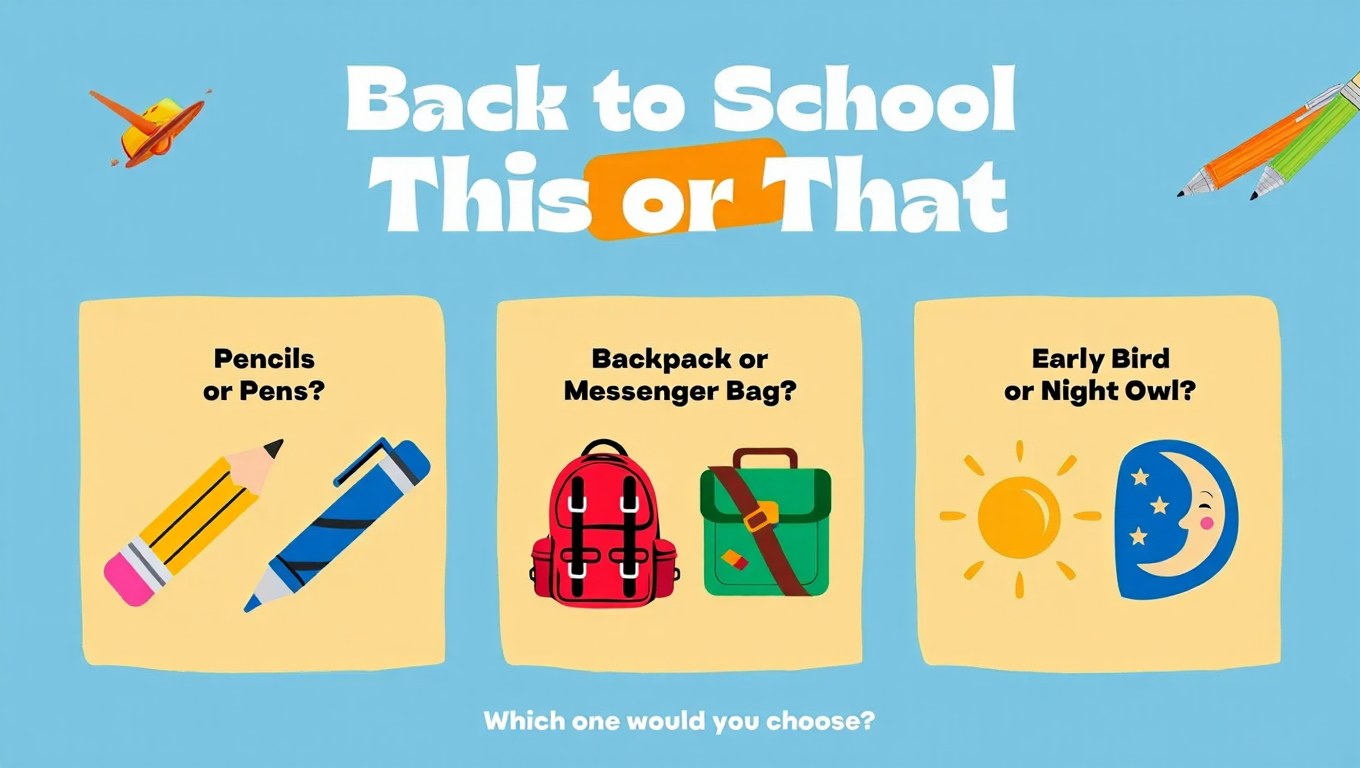
250+ This or That Questions for Back to School: The Ultimate Icebreaker Guide for Teachers and Students
Going back to school is exciting and scary at the same time. You have new faces to meet, teachers to impress, and friends to make. This or that questions for back to school are a great way to do this. They are fun and get you talking without the pressure of getting to know you questions and prompts.
Think about being in a new class and the last thing you want is someone to ask you to tell them 3 things about yourself. It’s scary! But when someone asks you to choose between pizza or tacos, that is not scary at all. It’s fun! This is how you build realtionships in your classroom through engaging questions and conversation.
In this guide you will find 250+ back to school this or that questions for the new school year. Organized for teachers, students, and parents. You’ll find age appropriate prompts and questions for every grade, how to facilitate this or that questions in the classroom based on child development, digital activities for online school, and answers to the most asked teacher questions about how to run this activity.
What Are This or That Questions and Why Do They Work So Well?
This or that questions are forced-choice during icebreaker time; here you get two options you can pick one. No essays. No explanations required (unless you want to give one). Just a simple choice that reveals something about you — a lightweight form of what educators call low-stakes participation.
Here’s why they work so well in school settings, from a classroom-management and child-development standpoint:
- There’s no wrong answer. You can’t mess up when you’re choosing between cats and dogs, which removes the fear of judgment that blocks participation in more open-ended icebreakers.
- Everyone can participate, regardless of verbal fluency, confidence level, or English proficiency. Even the quietest student in class has an opinion about summer versus winter.
- They’re fast. You can move through ten prompts in five minutes, and suddenly a room of strangers knows something real about one another.
- They reveal personality without forcing disclosure. When someone chooses “stay up late” over “wake up early,” you learn about their chronotype and habits. When they pick “mountains” over “beach,” you learn about their ideal environment. Small choices, added together, sketch a real picture of who a person is.
This forced-choice format is a well-known tool in early-childhood and social-emotional learning (SEL) curricula precisely because it lowers the cognitive and emotional barrier to speaking up. Similar to this or that questions for elementary students, these prompts meet students where they are developmentally — no pressure, no judgment, just honest, structured preference-sharing that builds classroom trust over time.
How Do You Actually Use These Questions in Class?
The ways of asking are at least as important as the questions themselves. The choice depends on class size, age, available technology, and time. These are the five methods that have proved effective in practice.
The Stand-Up-and-Move Method
This is the go-to for younger kids who need to burn kinetic energy while learning. You ask a question, then students physically move to different sides of the room based on their answer — pizza lovers go left, taco lovers go right.
Kids love this method because they get to move. Teachers love it because you can assess the whole room’s response at a glance — a built-in visual poll. Students also realize they’re not alone in their preferences; a shy student who loves reading might spot three other book-lovers across the room.
Facilitation tip: Mark the two sides of the room with tape or existing classroom features to prevent aimless wandering, and add a “middle zone” for students who are torn.
Partner or Small-Group Discussions
Break students into pairs or groups of four, and give them a set of prompts to work through together. This is a good option for older students who can work independently with less structure.
Students feel safer sharing their ideas with small groups rather than the whole class. Children will share more fully with a small group – explaining their reasoning in detail, rather than just stating an answer. Also have students take turns asking questions, keeping time, and recording answers so that everyone has a role if you use small groups.
Digital Polls and Online Tools
If your classroom has access to technology, there are ways to allow students to anonymously submit their answers through programs like Kahoot, Google Forms, and Mentimeter. It’s especially useful for sensitive subjects as students are more likely to be honest behind a screen. Many of these can have the data exported as well, allowing you to see a trend for the class on whatever topic you are using.
Just like this or that questions adapt to different formats, digital polling tools make the activity feel fresh, gamified, and modern — a good match for tech-native students.
Journal or Writing Prompts
Assign a this-or-that question as a daily journal topic and ask them to discuss their choice and reasoning. This less intimidating option plays more to the strengths of quiet kids who prefer to think before they speak, and supports skills development in metacognition and written communication that might not otherwise be developed.
Quick Morning Meeting Starter
Create a morning meeting or homeroom ritual in which you ask the group as a whole to share one question they have with you. Go around the circle, and if students wish to add a question, they can do so. This five minute ritual provides predictability that anxious students need, and it also reinforces the SEL competency that everyone’s voice is valued every day.
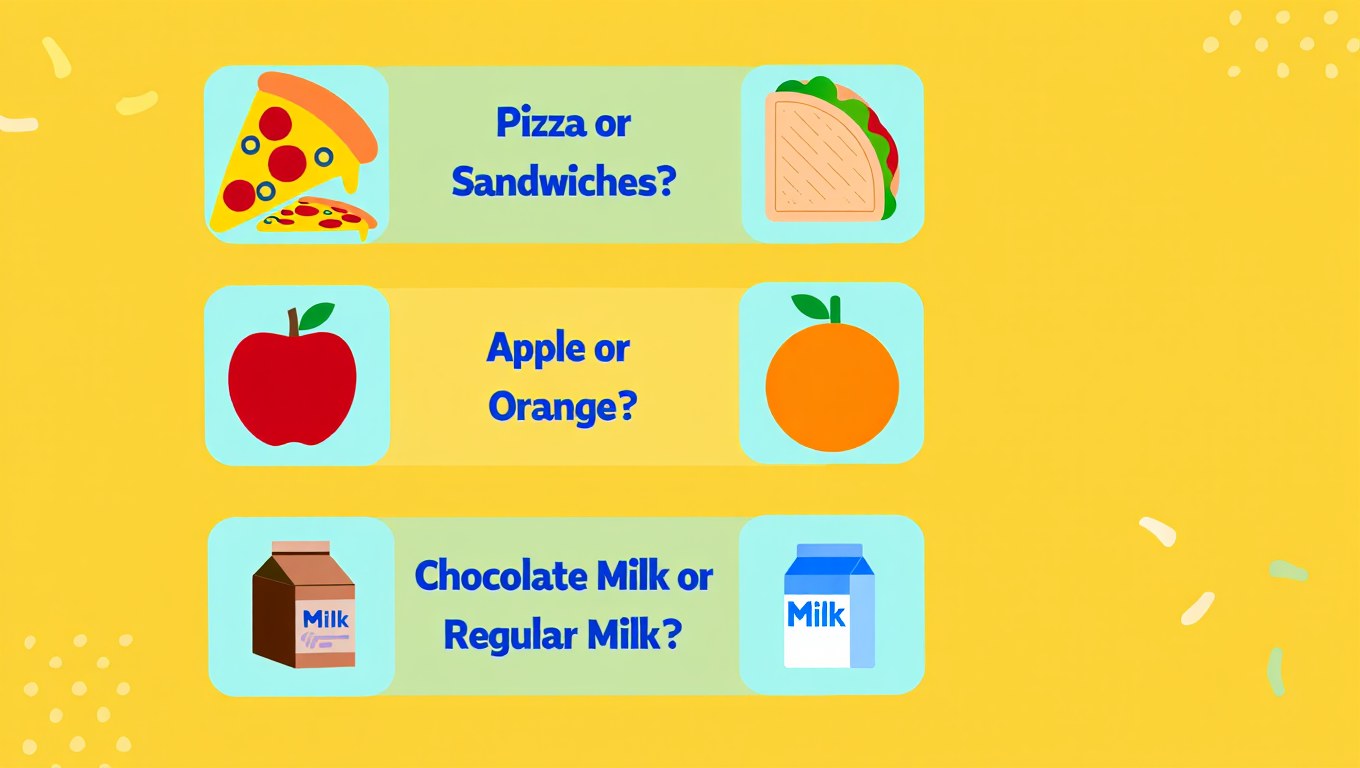
Food and Drink This or That Questions
Food is the great equalizer; everyone eats it, everyone has an opinion on it, and it tends to spill out information on cultural background and home life of people without them even having to say much.
Sweet vs. Savory
- Sweet breakfast or savory breakfast?
- Chocolate or vanilla?
- Sweet popcorn or salty popcorn?
- Candy or chips?
- Donuts or bagels?
Meal and Snack Choices
- Pizza or tacos?
- Burgers or hot dogs?
- Pasta or rice?
- Chicken or beef?
- Sandwich or wrap?
Drink Preferences
- Water or juice?
- Hot chocolate or apple cider?
- Lemonade or iced tea?
- Smoothies or milkshakes?
- Coffee or tea? (older students)
Specific Food Debates
- Pancakes or waffles?
- French fries or onion rings?
- Cookies or brownies?
- Ice cream or frozen yogurt?
- Pretzels or popcorn?
Fruit and Vegetable Picks
- Apples or oranges?
- Strawberries or blueberries?
- Carrots or celery?
- Grapes or cherries?
- Watermelon or cantaloupe?
Breakfast Battles
- Cereal or oatmeal?
- Scrambled eggs or fried eggs?
- Toast or English muffins?
- Bacon or sausage?
- Yogurt or cottage cheese?
Dessert Decisions
- Cake or pie?
- Gummy candy or chocolate candy?
- Popsicles or ice cream bars?
- Cupcakes or muffins?
- Pudding or Jell-O?
Restaurant and Fast Food
- Sit-down restaurant or fast food?
- Drive-through or eat inside?
- Chinese food or Mexican food?
- Subway or Chipotle?
- McDonald’s or Burger King?
Cooking and Eating Styles
- Home-cooked meals or takeout?
- Spicy food or mild food?
- Crunchy peanut butter or smooth peanut butter?
- Ketchup or mustard?
- Ranch dressing or Italian dressing?
Controversial Food Questions
- Pineapple on pizza: yes or no?
- Milk before cereal or cereal before milk?
- Hard shell tacos or soft shell tacos?
- Deep dish pizza or thin crust pizza?
- Boneless wings or traditional wings?
These prompts can also serve as a means of assessing cultural responsiveness since they allow for students to discuss their family tradition, diet, and cultural identity without targeting any particular individual. Similar in spirit to this or that food questions, these spark genuine debate that goes well beyond a simple yes-or-no.
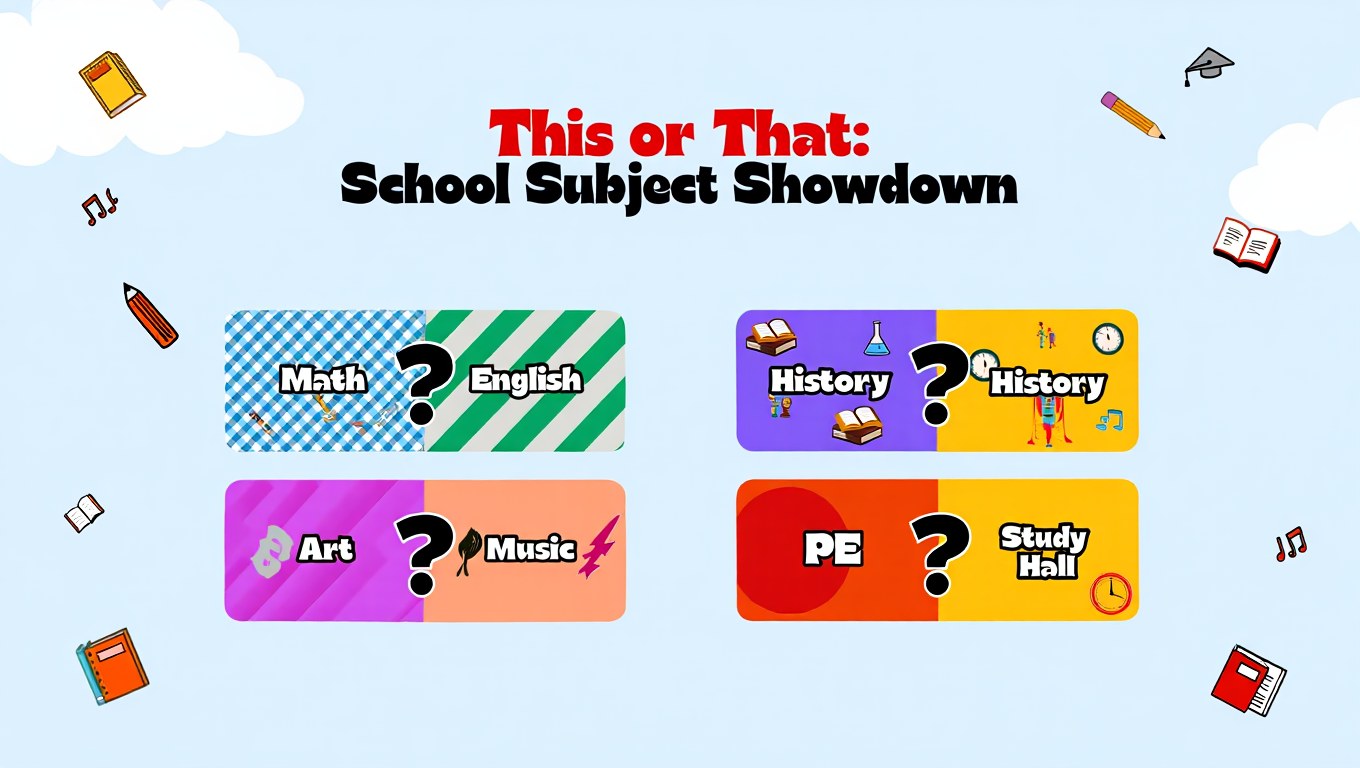
School and Learning This or That Questions
These questions can also be used as a simple learning-styles inventory. They enable students to think about their own preferences and also provide useful information to help teachers with instruction.
Subject Preferences
- Math or English?
- Science or social studies?
- Art or music?
- Gym or library time?
- Reading or writing?
Learning Style Questions
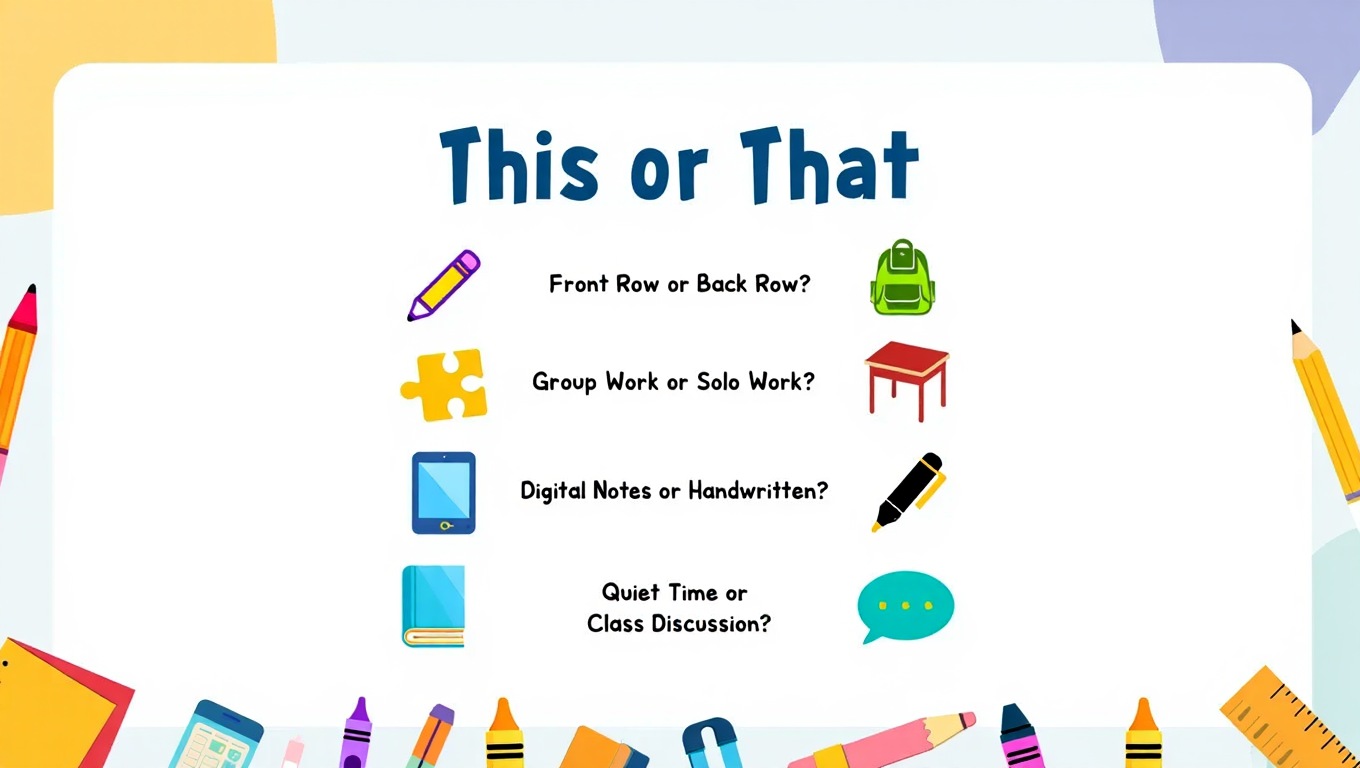
- Group projects or working alone?
- Taking notes by hand or typing?
- Learning from videos or learning from books?
- Visual learning or auditory learning?
- Morning classes or afternoon classes?
School Day Choices
- Packed lunch or cafeteria lunch?
- Arriving early or leaving late?
- Indoor recess or outdoor recess?
- Sitting in front or sitting in back?
- Pen or pencil?
Homework and Study Habits
- Homework right after school or homework after dinner?
- Study at a desk or study on the couch?
- Music while studying or complete silence?
- Study alone or study with friends?
- Flashcards or practice tests?
Activities and Extras
- Sports or clubs?
- Band or choir?
- Drama club or debate team?
- Yearbook or student council?
- Field trips or special classroom events?
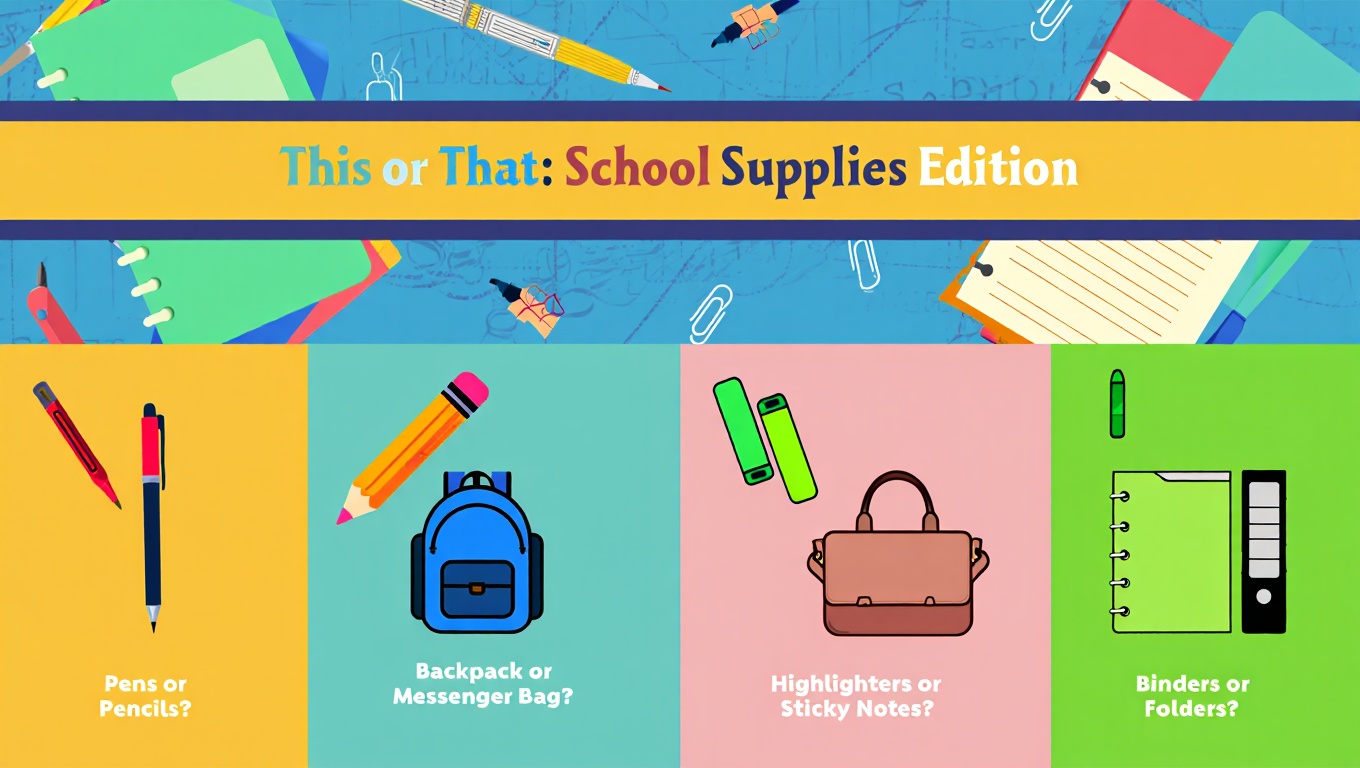
School Supplies
- Backpack or messenger bag?
- Binders or folders?
- Highlighters or colored pens?
- Laptop or tablet?
- Digital planner or paper planner?
Classroom Setup
- Desks in rows or desks in groups?
- Assigned seats or choosing your own seat?
- Whiteboard or smartboard?
- Natural lighting or bright overhead lights?
- Quiet classroom or collaborative noise?
Testing and Assessment
- Multiple choice or essay questions?
- Projects or presentations?
- Open-book tests or closed-book tests?
- Tests or quizzes?
- Oral presentations or written reports?
If a majority of your class leans toward visual-learning answers, that’s your cue to add more diagrams, charts, and video content to your lessons. Just as this or that questions for kindergarten get simplified for younger learners, you can scale these up for older students — high schoolers might debate AP classes versus electives, while this or that questions for elementary students stick to crayon brands and recess games. For teen-specific prompts, see this or that questions for high school students and this or that questions for middle schoolers.
Entertainment and Social Media
Entertainment prompts tend to relate to things outside of school that students like to do or be a fan of because they help them learn more about their interests. They can also bring up interesting topics between students that otherwise would not have anything in common.
Movies and TV
- Movies or TV shows?
- Comedy or action?
- Animated movies or live-action movies?
- Movie theater or streaming at home?
- Scary movies or happy movies?
Streaming and Watching Habits
- Netflix or Disney Plus?
- YouTube or TikTok?
- Watching alone or watching with family?
- Binge-watching or one episode at a time?
- Subtitles on or subtitles off?
Music Preferences
- Pop music or rock music?
- Current hits or oldies?
- Concert or music festival?
- Singing along or just listening?
- Earbuds or headphones?
Gaming Questions
- Video games or board games?
- Xbox or PlayStation?
- Single-player games or multiplayer games?
- Mobile games or console games?
- Minecraft or Roblox?
Social Media
- Instagram or Snapchat?
- Posting content or scrolling content?
- Photos or videos?
- Public profile or private profile?
- Following celebrities or following friends?
Books and Reading
- Fiction or nonfiction?
- Physical books or e-books?
- Library or bookstore?
- Series or standalone books?
- Reading at night or reading in the morning?
Creative Content
- Creating art or viewing art?
- Drawing or painting?
- Writing stories or reading stories?
- Taking photos or being in photos?
- Making videos or watching videos?
Sports and Activities
- Playing sports or watching sports?
- Team sports or individual sports?
- Indoor activities or outdoor activities?
- Swimming or hiking?
- Skateboarding or biking?
Entertainment questions feel less like “school stuff” and more like a genuine conversation — students light up when their favorite game or show comes up. You can also mine the answers for lesson-planning material: if half your class is obsessed with a particular game, reference it when explaining a tricky concept. These prompts work similarly to this or that questions for girls and this or that questions for boys in that they tap directly into current pop-culture trends students already care about.
Personality and Preference Questions
These go deeper — into values, decision-making style, and self-concept. Save them for once students already know each other, when the group feels safe enough for more personal disclosure.
Social Preferences
- Big party or small gathering?
- Lots of friends or few close friends?
- Meeting new people or spending time with known friends?
- Texting or calling?
- Group chat or one-on-one conversations?
Personality Traits
- Early bird or night owl?
- Organized or spontaneous?
- Planner or go with the flow?
- Leader or follower?
- Thinker or doer?
Comfort and Lifestyle
- Stay home or go out?
- Routine or variety?
- Comfortable clothes or fashionable clothes?
- Sneakers or sandals?
- Hoodie or jacket?
Decision Making
- Heart or head?
- Risk-taker or play it safe?
- Ask for help or figure it out yourself?
- First to try something new or wait and see?
- Speak up immediately or think it over first?
Time and Productivity
- Morning person or evening person?
- Early to everything or fashionably late?
- Multitasking or focusing on one thing?
- Work ahead or last-minute rush?
- To-do lists or mental notes?
Communication Style
- Talk it out or write it down?
- Direct communication or subtle hints?
- Humor or seriousness?
- Loud or quiet?
- Lots of details or just the basics?
Values and Priorities
- Quality time or words of affirmation?
- Saving money or spending money?
- Adventure or security?
- Fame or privacy?
- Success or happiness?
Future Thinking
- Live in the moment or plan ahead?
- City life or country life?
- Travel the world or have a stable home?
- Follow your passion or choose financial security?
- Change the world or change yourself?
These deeper prompts build genuine peer connection — students discover shared values with classmates they assumed were nothing alike, and they practice respecting differing perspectives. The answers also give teachers insight into student motivation: a security-minded student may need more reassurance before a new challenge, while an adventure-minded one may need extra structure to stay on task. Pair these with goal-setting strategies for success or discussions around short-term goal examples to connect the “future thinking” category to real SEL curriculum. The same conversation-building principle powers family-oriented variants like this or that questions for cousins, this or that questions for brother, and this or that questions family.
Seasonal and Holiday Questions
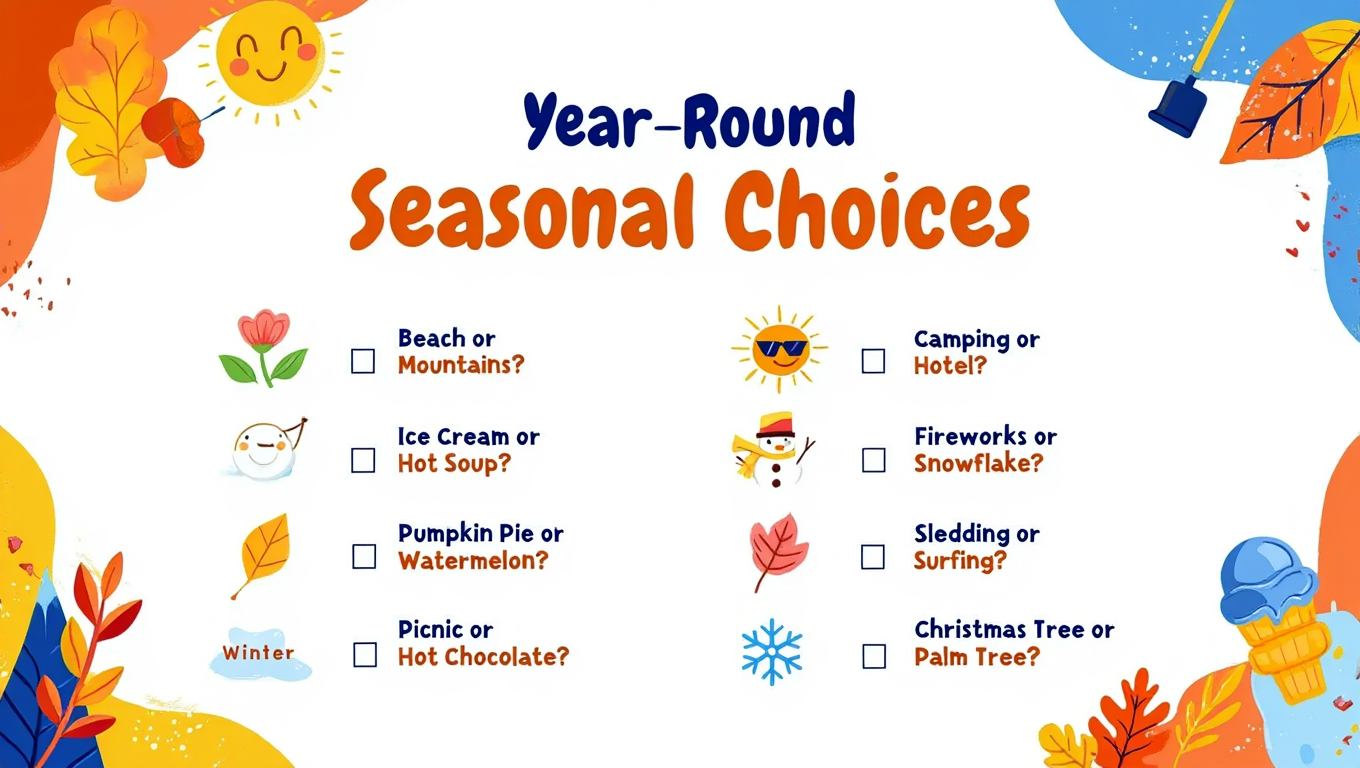
Seasonal prompts tie the activity to the calendar and give you an easy bridge into science and geography lessons — discussing fall can lead naturally into why leaves change color; discussing winter can connect to climate-zone geography.
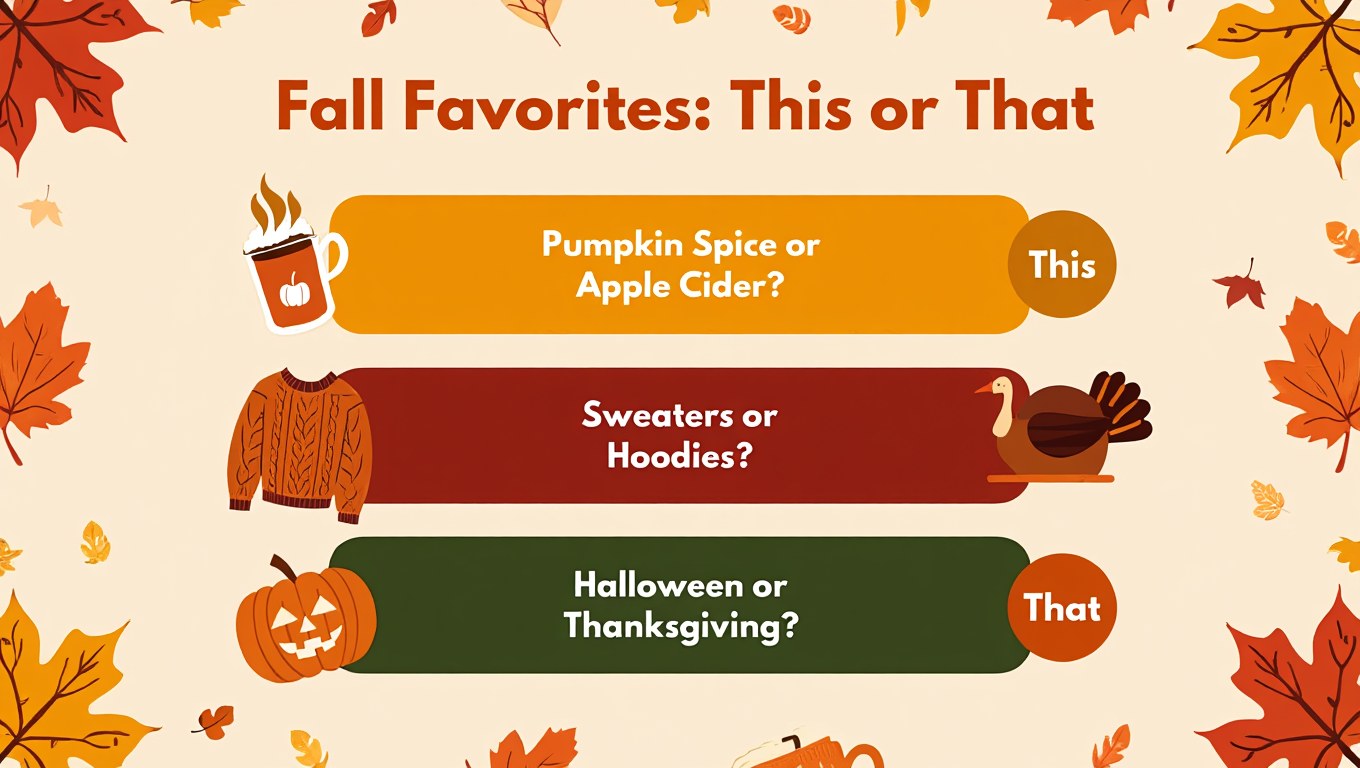
Fall and Back to School
- Summer or fall?
- Hot weather or cool weather?
- Beach days or cozy days?
- Ice cream or hot chocolate?
- Flip-flops or boots?
Halloween Specific
- Trick-or-treating or handing out candy?
- Scary costumes or funny costumes?
- Haunted houses or pumpkin patches?
- Chocolate candy or fruity candy?
- Carving pumpkins or painting pumpkins?
For more spooky-season prompts, see this or that questions for Halloween.
Winter and Holiday Season
- Snow or no snow?
- Skiing or snowboarding?
- Building snowmen or having snowball fights?
- Christmas or Hanukkah? (cultural sensitivity required)
- Hot cocoa or apple cider?
New Year and Winter Break
- New Year’s Eve party or early bedtime?
- Making resolutions or skipping resolutions?
- Winter break or summer break?
- Staying up late or sleeping in?
- Family celebrations or friend celebrations?
Curious what students might choose for their own resolutions? Pair this section with New Year’s resolution ideas.
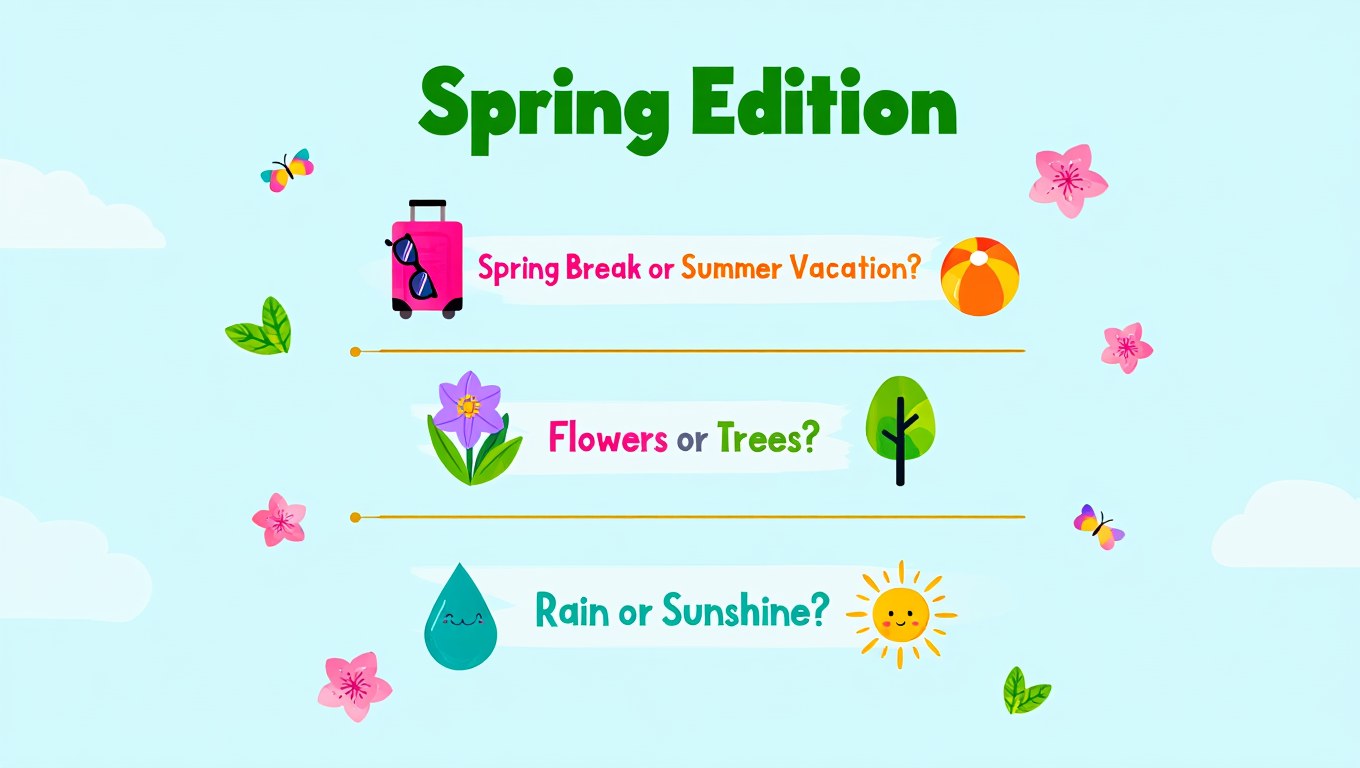
Spring and End of School
- Spring or summer?
- Rain or sunshine?
- Flowers blooming or leaves falling?
- Spring break or summer vacation?
- End-of-school countdown or enjoying each day?
Summer Activities
- Pool or ocean?
- Summer camp or staying home?
- Sleeping late or early morning adventures?
- Road trip or flying somewhere?
- Staying cool inside or being outside anyway?
Weather Preferences
- Sunny days or rainy days?
- Thunderstorms or clear skies?
- Snow days or regular school days?
- Windy or calm?
- Foggy mornings or bright mornings?
Seasonal Activities
- Raking leaves or jumping in leaves?
- Spring cleaning or keeping things messy?
- Growing a garden or buying from the store?
- Outdoor sports or indoor sports?
- Seasonal decorating or keeping things simple?
Random and Fun Questions
Sometimes you just need silly, high-energy prompts to reset the room. These lighthearted “would you rather”-style options work great when the class needs a laugh or you want to close the week on a fun note.
Silly Hypotheticals
- Superpower: flying or invisibility?
- Time travel: past or future?
- Talking to animals or speaking all languages?
- Never sleep or never eat?
- Live in a treehouse or live on a boat?
Would You Rather Scenarios
- Be the funniest person or the smartest person?
- Always be too hot or always be too cold?
- No phone or no TV?
- Rewind time or pause time?
- Know everything or be able to do anything?
Animal Comparisons
- Cats or dogs?
- Wild animals or pets?
- Birds or fish?
- Dinosaurs or dragons?
- Real animals or mythical creatures?
Transportation
- Car or truck?
- Flying or driving?
- Train or plane?
- Bike or scooter?
- Walking or running?
Living Situations
- Mansion or cozy cottage?
- Apartment or house?
- City or suburbs?
- Mountains or beach?
- Forest or desert?
Talents and Abilities
- Play an instrument or speak multiple languages?
- Athletic ability or artistic ability?
- Photographic memory or speed reading?
- Always know the right thing to say or always know when someone’s lying?
- Mind reading or seeing the future?
Color and Design
- Bright colors or neutral colors?
- Patterns or solid colors?
- Modern style or vintage style?
- Minimalist or maximalist?
- Rainbow or monochrome?
Random Choices
- Pancakes or waffles? (yes, again — it’s that important)
- Socks with sandals: yes or no?
- Pens or markers?
- Staying up late or waking up early?
- Being famous or being rich?
Weird Questions
- Would you rather fight one horse-sized duck or 100 duck-sized horses?
- Have fingers for toes or toes for fingers?
- Sweat maple syrup or cry hot sauce?
- Have a rewind button or a pause button for life?
- Always tell the truth or always lie?
Students remember the day you asked whether they’d fight a horse-sized duck — they’ll bring it up months later. The absurdity lowers social walls and teaches respectful disagreement over something that genuinely doesn’t matter. For more hypothetical-style prompts, browse what if questions to ask, truth or dare questions, and trap questions to get to know someone.
How Do Different Age Groups Respond to These Questions?
Elementary, middle, and high school students need different approaches. What lands with a kindergartner will bore a teenager, and vice versa.
Elementary school (grades K–5) students respond best to concrete, visual choices — “dogs or cats?” makes sense; “introvert or extrovert?” does not yet. They also need physical movement built in, since sitting still for long discussion isn’t developmentally realistic at this age. Expect quick, unreflective answers; volume matters more than depth. See this or that questions for elementary students and this or that questions for kindergarten for grade-specific banks.
Middle school (grades 6–8) students can handle more abstract concepts as they build identities separate from family. They’re highly social but also self-conscious — small-group formats work better than whole-class sharing at this age, since the buffer reduces social anxiety. Middle schoolers also love debating their choices, which builds persuasive-communication skills. See this or that questions for middle schoolers and this or that questions for students for more.
High school (grades 9–12) students crave authenticity and depth — surface-level prompts bore them. Questions about future goals, values, and (age-appropriate) ethical dilemmas land better. Offer multiple participation formats (private writing, pair-share, group discussion) since privacy preferences vary widely at this age. See this or that questions for high school students.
Maturity varies within any age group — treat grade level as a starting point, not a rule.
What Makes a Good This or That Question for School?
Not every this-or-that prompt works equally well in an educational setting. The strongest first day of school this or that questions share several traits:
- Age-appropriate — matched to students’ developmental stage and interests.
- No objectively “better” answer — both options should be equally valid, so students answer honestly instead of picking what sounds acceptable.
- Meaningful — even a silly-sounding question (“cats or dogs?”) should reveal something about preference, values, or home life.
- Culturally inclusive — avoid assuming every student celebrates the same holidays or eats the same foods; build in an opt-out path when a prompt doesn’t apply.
- Discussion-generating — the answer is a starting point, not the finish line. “Summer or winter?” should lead somewhere.
- Appropriately timed — save deeper, values-based prompts for after trust is established; open with food and entertainment, not personal values.
Avoid politically or religiously divisive prompts unless you’re intentionally teaching structured debate and are prepared to moderate carefully.
How Can You Create Your Own This or That Questions?
Once you know what makes a prompt work, building your own bank is easy.
- Start with a purpose. Community-building questions lean personal-preference; academic questions connect to curriculum (“Greek or Roman culture?” for an ancient civilizations unit; “team protagonist or team antagonist?” for a novel study).
- Mine student conversation. Listen to what they’re already talking about — trending games, songs, shows — and build prompts around it.
- Use sentence frames like “[blank] or [blank]?”, “more [blank] or more [blank]?”, or “[adjective] or [opposite adjective]?” to generate ideas fast.
- Localize generic questions. “Gym or library?” becomes “playing basketball or reading in the book nook?” — specifics your students actually experience land better than generic ones.
- Test it on yourself first. If you can’t answer easily, or one option is clearly “better,” rework it.
- Crowdsource from students. Have them submit their own prompts as a quick writing task, then vote on favorites as a class.
When Is the Best Time to Use This or That Questions?
- First day and first week — breaks the ice fast without the discomfort of formal introductions.
- Monday mornings — an easy energy boost after the weekend.
- Friday afternoons — refocuses a checked-out room before dismissal.
- Before tests — a quick, silly prompt eases anxiety and resets the mindset.
- After long breaks — rebuilds classroom community after winter, spring, or summer break.
- During transitions — settles students after lunch or bridges one subject into the next.
- Before group projects — helps students preview potential partners’ communication styles.
- When a lesson plan falls apart — zero prep, zero materials, instant fallback.
- During SEL time — deeper prompts about values and decision-making fit naturally into social-emotional learning curricula.
Avoid overuse. Once or twice a week keeps the activity feeling special instead of routine filler.
How Do This or That Questions Help Shy or Anxious Students?
Traditional icebreakers often leave anxious students behind — this format levels the field.
- Reduced decision paralysis: two options, not infinite ones, feel manageable to an overthinking mind.
- Built-in equality: a one-word answer counts the same as a five-minute explanation.
- Movement-based options (the stand-up-and-move method) let a shy student answer without speaking at all.
- Written and anonymous formats — sticky notes, journals, anonymous digital polls — remove the social spotlight entirely.
- Pair work before group work builds confidence gradually, starting with an audience of one.
- Observation reduces fear — watching classmates answer first proves there’s no “trick” and no judgment coming.
Similar in effect to conversation topics to talk about with friends and family, the structure itself is what makes anxious participants feel safe. For more on supporting these students long-term, see signs of low self-esteem and how to build self-esteem.
What Are Common Mistakes Teachers Make With This or That Questions?
- Asking questions with an obvious “acceptable” answer (“bullying or kindness?”) — not a real choice.
- Assuming universal cultural context (holidays, diets) without an opt-out.
- Rushing past the follow-up discussion, where the real learning happens.
- Going too deep too soon, before trust is built.
- Not participating yourself — students want to know your answers too.
- Forcing a reluctant student to answer, which damages trust.
- Repeating the same questions until they lose their spark.
- Letting mocking or judgmental reactions go unaddressed.
- Treating the activity as a disconnected time-filler instead of tying it to a lesson.
- Stacking too many similar-category questions in a row.
How Can Parents Use These Questions at Home?
“How was school?” reliably gets a one-word answer. “What was better today, math or science?” gets an actual conversation. These prompts work at the dinner table, during car rides, or as part of a bedtime routine — giving kids a low-pressure structure for talking about their day. Just as this or that questions for husband and wife strengthen adult relationships through the same mechanism, family-oriented rounds build parent-child connection and even create long-running family inside jokes. Long car rides also pair well with funny first date questions-style prompt banks repurposed for family fun, or a round of knock-knock jokes for kids between rounds.
Can These Questions Work for Online or Virtual Classrooms?
Yes — arguably virtual classrooms need them more, since screen-based isolation makes community-building harder.
- Chat responses for quick, simultaneous participation.
- Native polling features in Zoom, Google Meet, or Microsoft Teams for anonymous, instantly visualized results.
- Breakout rooms to mimic small-group discussion.
- Virtual backgrounds as a creative, visual way to “vote.”
- Reaction emojis for one-click participation.
- Shared documents for written responses from quieter students.
- Gamified platforms like Kahoot or Quizizz to add competitive energy.
Consistency matters even more online — opening every session with one question helps students transition into “school mode” from home.
What Should You Do With the Answers You Collect?
- Note interesting answers and use them to personalize instruction and examples.
- Form interest-based groups (book clubs, game days) from shared preferences.
- Display class-wide results visually — bulletin boards, simple graphs — so the room feels co-owned.
- Reference past answers in later conversations to show students you were listening.
- Check in privately with outliers whose answers consistently differ from the group.
- Adjust teaching approach based on learning-preference trends.
- Save question banks and responses year over year to compare cohorts.
How Do You Keep This or That Questions Fresh All Year?
- Rotate delivery format weekly — movement, digital poll, writing, verbal.
- Rotate categories — food, then personality, then school, then seasonal.
- Let students write and lead the questions themselves.
- Tie prompts to current events, spirit week, or school happenings.
- Add light competition — team debates or tracked class trends over time.
- Combine with art, writing, or lesson content instead of running it in isolation.
- Build themed weeks (pet week, food week, sports week) for anticipation.
- Bring in guest answerers — the principal, counselor, or a student teacher.
Conclusion
This or that questions for back to school turn the start of a new school year from stressful into genuinely exciting. They help students connect quickly and authentically, and they let teachers learn about their class without forcing awkward, high-pressure sharing.
This guide gave you 250+ questions across eight categories, classroom-tested facilitation methods for every age group and setting — in person or virtual — plus guidance on writing your own prompts, avoiding common pitfalls, and keeping the activity fresh all year.
Pick five questions from any category above. Try one facilitation method. Watch strangers become classmates, and classmates become friends — one simple choice at a time.
You May Also Like
 Fun Questions
1500+ This or That Questions for 2026: From Silly Choices to Deep Conversations
 Fun Questions
What Does WSG Mean in Text? How to Respond to WSG in Messages and Social Media
 Fun Questions
350+ Truth or Dare Questions: Play Classic Party Games With Your Friends
 Fun Questions
157+ This or That Questions for Cousins: Fun Conversations
 Fun Questions
155+ This or That Questions for Black People: A Complete Cultural Connection Guide
 Fun Questions
What Does GNG Mean in Text? Meaning Slang, Examples, and Real Usage
 Fun Questions
What Does SYBAU Mean? SYBAU Slang Meaning, Origin & Examples
 Fun Questions
What Does OTW Mean in Text? Meaning, Origin, and Real Examples
 Fun Questions