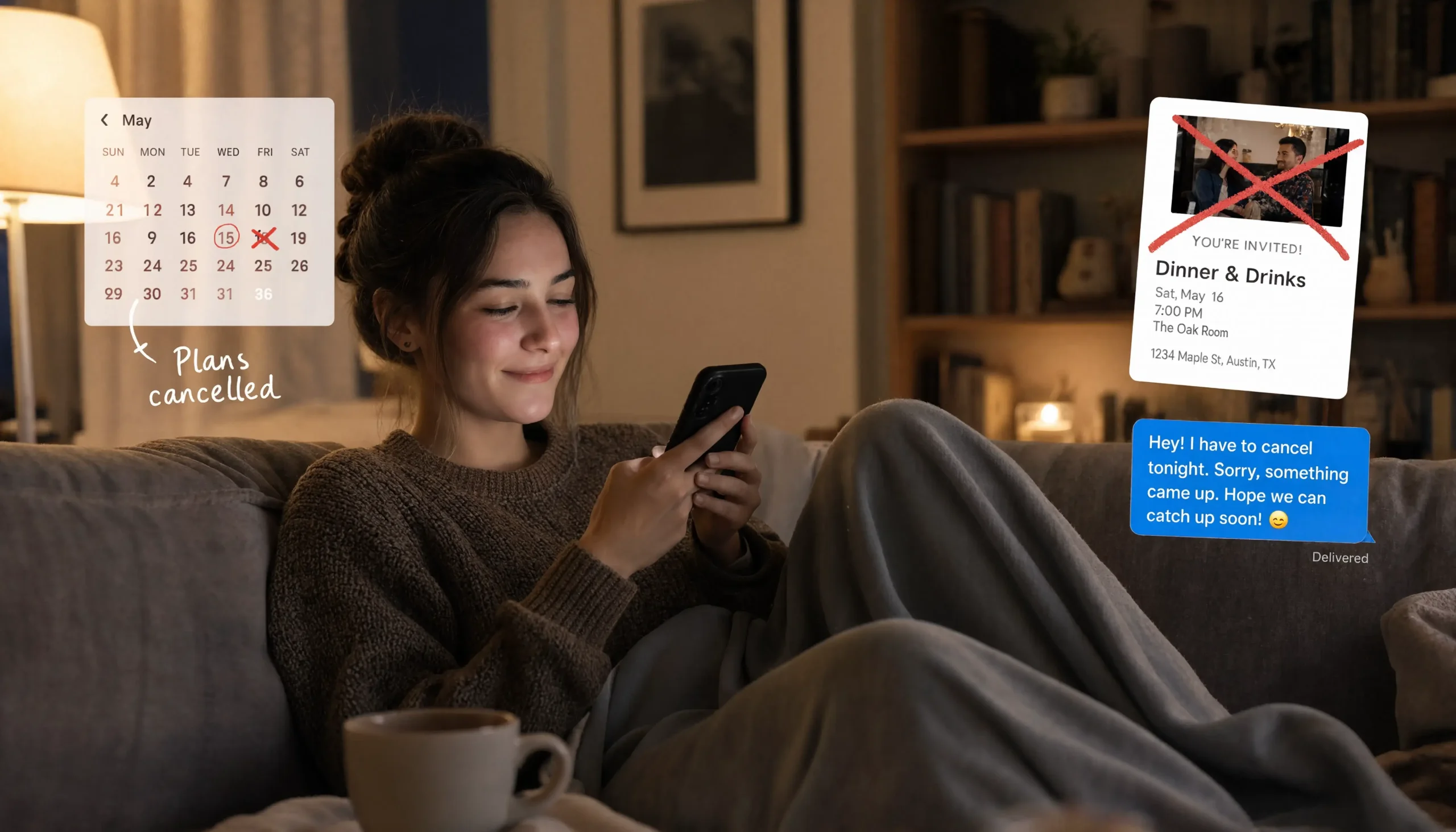
How to Cancel Plans Without Feeling Bad
I once spent forty-five minutes writing a two-sentence text. It said something like “Hey, I’m so sorry, I don’t think I can make it tonight, I hope that’s okay.” Forty-five minutes for eighteen words, because every version felt either too cold or too desperate, like I owed someone a full legal defense for wanting a quiet night in. If that sounds familiar, you already know the real problem was never the message. It was the guilt sitting underneath it.
We tend to treat guilt like proof that we did something wrong. In reality, guilt over canceling plans is often just an old habit talking, one built from years of learning that our worth was tied to being available, agreeable, and endlessly reliable. They call it people-pleasing in psychology circles, but it rarely feels that clinical from the inside. It just feels like dread, followed by a text you rewrite four times, followed by a strange kind of relief once you finally hit send.
This guide is not about becoming someone who cancels plans casually or without care. It is about learning to change your mind, protect your energy, and say no without the guilt spiral that usually follows. If you already know you cancel too often and want to actually shift that pattern, there is a separate guide for actually breaking that cycle worth reading alongside this one. But if the real issue is not the canceling itself, just the wave of guilt that comes with it, keep reading. This one is for you.
Why Canceling Plans Feels So Guilty in the First Place
Canceling plans feels heavy because it forces a small, private negotiation between two things we were taught to value equally: honoring our own needs and honoring our commitments to other people. Most of us were never taught how to hold both of those at once. We were taught that a good friend, a good partner, a good coworker shows up, no matter what, and that anything less makes us unreliable.
That belief usually starts early. A child who cancels a promised visit to a friend’s house might hear a parent say, “You committed to this, you have to go.” A teenager who backs out of a group hangout might get labeled flaky by their friends, a word that sticks longer than anyone intends it to. By adulthood, we carry that word around like a warning label, terrified of becoming the person everyone quietly stops inviting.
They are not wrong to notice patterns. Reliability matters in relationships, and a habit of last-minute cancellations really can wear on the people around us over time. But there is a difference between a pattern that damages trust and a single honest decision to protect your own bandwidth. Guilt does not usually make that distinction on its own. It just shows up, loud and undiscerning, whether you cancel once a year or once a week.
The Difference Between Guilt That Helps and Guilt That Hurts
Not all guilt deserves the same response. Some guilt is useful information, a signal that you have let someone down in a way that actually matters. Other guilt is just noise, an old alarm system going off because you did something that used to be unsafe in some other context, long before now.
Useful guilt tends to be specific. It sounds like, “I canceled on my best friend three times this month, and I know that has hurt her.” That kind of guilt points toward a real repair: a conversation, an apology, a change in behavior. Unhelpful guilt tends to be vague and enormous. It sounds like, “I am a bad person for wanting a night to myself,” which is not actually about the plan at all. It is about a belief that your needs are only acceptable when they do not inconvenience anyone else.
Learning to sort one from the other takes practice. We often assume every twinge of guilt is a moral verdict, when really, a lot of it is just the deeper work of feeling secure enough to disappoint someone without spiraling into shame about it. That security does not appear overnight, but noticing the difference between useful and unhelpful guilt is a real first step toward building it.
Give Yourself Permission to Change Your Mind
Somewhere along the way, many of us absorbed the idea that once we say yes, the decision is locked, regardless of how we feel closer to the actual day. But needs change. Energy changes. A week that looked manageable on paper can turn into one where the idea of getting dressed and leaving the house feels like scaling a wall.
I used to think changing my mind meant I had failed at planning correctly, as if a better version of me would have predicted my own exhaustion three weeks in advance. That is an unfair standard to hold yourself to. You are allowed to reassess a commitment as new information arrives, including information as simple as I am more tired than I expected to be.
This does not mean every plan becomes optional the moment it feels inconvenient. It means treating your own limits with the same kindness you’d offer a friend in the same situation. If a friend told you they were too drained to come tonight, you would likely tell them it’s fine, that their wellbeing matters more than one evening. Try offering yourself that same grace instead of reserving it only for other people.
How to Actually Say It Without Over-Explaining
The guilt often gets worse in the space between deciding to cancel and actually sending the message. We rehearse. We draft. We imagine every possible reaction, then write a message long enough to preempt all of them at once. In practice, a short, honest message almost always lands better than a long, defensive one.
A few principles make this easier:
- Say it plainly. “I’m not going to be able to make it tonight” is a complete sentence. It does not need three qualifiers in front of it.
- Skip the manufactured excuse. A vague, false reason often creates more anxiety than an honest one, because now you also have to remember the story you told.
- Offer a next step if you mean it. “Can we plan for next weekend instead?” shows the relationship matters, even when tonight does not work.
- Send it as early as you know. The guilt tends to compound the longer you wait, and so does the inconvenience for the other person.
Finding the right handful of words instead of a five-paragraph explanation nobody asked for usually takes less effort than we expect once we stop trying to control how the other person feels about it. You can be kind and brief at the same time. Those two things are not in competition with each other.
What Canceling Without Guilt Does Not Mean
It is worth naming clearly: learning to cancel without guilt is not the same as canceling without care. This is not permission to treat every plan as disposable or to leave people waiting on a response that never comes. The goal here is a healthier relationship with your own limits, not a smaller sense of responsibility toward others.
We sometimes worry that letting go of guilt will turn us into someone unreliable, as if guilt were the only thing keeping us considerate. In reality, the people who care most about showing up for others rarely need guilt to do it. They show up because they want to, and they extend themselves grace on the occasions they cannot. If guilt has been doing most of the heavy lifting in your relationships so far, that is worth examining on its own, separate from any single canceled plan.
The Stories We Tell Ourselves About Being Reliable
A lot of the guilt around canceling plans is really about identity, not logistics. Somewhere along the way, many of us built a piece of our self-worth around being the reliable one, the friend who never bails, the family member who always shows up. That identity can feel good to hold onto, right up until it starts costing more than it gives back.
They will tell you, if you ask, that they do not actually expect perfect attendance from the people they love. Most people extend far more grace to others than they extend to themselves, which says something about how much of our identity gets wrapped up in being “the reliable one” instead of just being a person with normal, fluctuating capacity. We build a whole story around a single trait and then feel like we are failing an exam every time real life gets in the way of it.
Letting a little of that story go does not mean giving up on being someone people can count on. It means recognizing that being human, with limits and changing energy, is not actually incompatible with being loved and trusted.
The Hidden Weight of Always Saying Yes
There is a cost to constant availability that rarely gets named directly. We talk about burnout in the context of work, but rarely in the context of our social lives, even though the same math applies. Every yes we give when we mean maybe, or even no, draws down a reserve of energy that does not refill itself just because the obligation was social instead of professional.
I have noticed, both in myself and in the people I talk to, that the guilt around canceling plans often shows up hardest during the exact weeks when saying yes to everything would have been the least sustainable choice. That timing is not a coincidence. Guilt tends to peak precisely when our capacity is lowest, which is backwards from how it should work. The moments we most need permission to protect our energy are often the moments guilt shows up loudest to argue against it.
We rarely calculate the real cost of overcommitment until we are already deep inside it: the missed sleep, the frayed patience, the sense of being stretched thin across every relationship instead of fully present in any one of them. A single honest cancellation, chosen early and communicated kindly, is often what keeps that math from tipping over into something harder to recover from, like resentment toward the very people we were trying not to disappoint.
When Canceling Actually Protects the Relationship
It can feel counterintuitive, but sometimes canceling a plan is what protects a relationship rather than damaging it. Showing up drained, distracted, or quietly resentful rarely makes for good company. They can usually tell the difference between a friend who is fully present and one who is just physically in the room, going through the motions until it is socially acceptable to leave.
A friend of mine once admitted that she used to force herself to every single gathering out of fear that skipping one would cost her the friendship. What she noticed instead, once she started being honest about her limits, was that her presence at the plans she did attend became warmer and more genuine. The relationships did not weaken. They actually deepened, because the time she did spend with people was time she genuinely wanted to be there, instead of time she was quietly counting down.
When the Guilt Is Really About Something Else
Sometimes the guilt attached to canceling plans is not really about the other person at all. It is about a fear of disapproval that goes back much further than any single evening plan. If the thought of disappointing someone brings on a wave of anxious what-ifs, replaying imagined reactions long after the message is sent, that pattern is often rooted in the same fear that makes any kind of disappointing someone feel unbearable, whether it shows up in friendships, romantic relationships, or even casual acquaintances.
I noticed this in myself the first time I canceled plans with someone I barely knew and still lay awake rehearsing apologies. The stakes were objectively low. The anxiety did not match them. That mismatch is often the clue that the guilt is less about the specific plan and more about an old belief that other people’s disappointment is dangerous, something to avoid at almost any cost, even the cost of your own rest.
Practical Ways to Let Go of the Guilt After You’ve Canceled
Once the message is sent, the work shifts from decision-making to self-regulation. The guilt does not always disappear the moment you hit send, and that is normal. A few small habits can help it pass more quickly instead of settling in for the whole evening.
- Name what actually happened. I canceled one plan is more accurate, and less catastrophic, than I let everyone down.
- Give the feeling a time limit. Sit with the discomfort for ten minutes instead of trying to force it away immediately. Most guilt softens once you stop fighting it.
- Do something restorative with the time you reclaimed. Guilt tends to grow when the evening feels wasted instead of used for the rest you actually needed.
- Resist the urge to over-apologize the next time you see them. One sincere acknowledgment is enough. Repeating it turns a small moment into a bigger one than it needs to be.
- Return to a few grounding truths when the guilt won’t quiet down on its own; a handful of simple, steady reminders can interrupt a spiral faster than trying to reason your way out of it in real time.
None of these steps erase the discomfort instantly. They just keep it from taking up more space than it deserves.
What Other People Actually Remember
One of the quieter truths about canceling plans is that other people rarely dwell on it the way we do. Psychologists call this the spotlight effect, the tendency to believe others are paying far more attention to our choices than they actually are. We replay our own canceled plans for hours. The other person, more often than not, has already moved on to something else entirely.
We assume the worst about what people think of us far more often than the evidence supports. This is not to say your friends or family do not notice a genuine pattern of unreliability, because they will, eventually. But a single honest cancellation, communicated early and kindly, rarely lives in someone else’s memory the way it lives in yours. If assuming the worst about what people think of us is a familiar habit for you, this particular worry is often part of a bigger pattern worth paying attention to, not just a reflection of this one evening.
Building a Life With Room for Both
The long-term goal here is not perfect guilt-free canceling. It is a life with enough flexibility built into it that changing your mind occasionally does not feel like a moral failure. That kind of balance takes ongoing attention, not a one-time fix. It means noticing when you are overcommitting before the guilt even has a chance to show up, and it means building a life that has enough room in it for your own needs too, not just everyone else’s expectations of you.
It also means remembering what actually makes someone a good friend to have around, which usually has far less to do with perfect attendance and far more to do with honesty, warmth, and showing up in the ways that matter most. A friend who tells you the truth about their capacity is, in most cases, easier to trust than one who says yes to everything and quietly resents you for it later.
You Are Allowed to Change Your Mind
Canceling a plan does not undo the value of the relationship behind it. It is a small, human moment of reprioritizing, not a character flaw waiting to be discovered. We spend so much energy protecting other people from the mild inconvenience of our absence that we forget our own rest and honesty deserve protecting too.
The next time you feel that familiar tightness in your chest before sending a cancellation text, try to remember this: a short, honest message sent with care rarely does the damage guilt convinces you it will. You are not required to earn your rest by suffering through every plan you once agreed to. You are just a person, doing your best to balance your own needs against everyone else’s, the same as everyone else trying to figure out exactly the same thing.
You May Also Like
 Family and Relationships
How We Strengthen Our Relationship in 24 Hours: A Real Couple’s Guide to a Healthy Relationship
 Friendship Quotes
200+ Thinking of You Quotes to Make Someone Feel Remembered
 Toxic Relationships
150+ Disappointment Relationship Priority Quotes: When You’re Not Their First Choice
 Things to Do
250+ Things to Talk About: Never Run Out of Conversation Ideas Again
 Family and Relationships
150+ Celebration of Life Quotes: Words to Celebrate Loved Ones
 Family and Relationships
150+ Questions to Ask in a Relationship: Get To Know Someone Better
 Family and Relationships
180+ Trust and Loyalty Quotes in Friendship & Relationships: Building Bonds That Last Forever
 Family and Relationships
100+ Inspirational Quotes for First Time Parents That Speak to Your Sleepless, Joyful Heart
 Family and Relationships