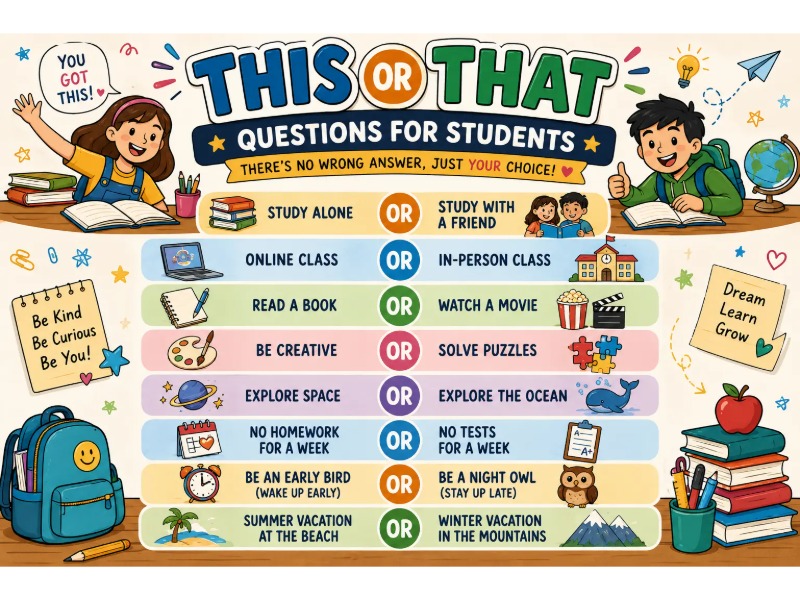
250+ This or That Questions for Students: Icebreakers, Brain Breaks & Class Games
Looking for this or that questions for students that actually get kids talking? This guide delivers 250+ ready-to-use prompts sorted by category, grade band, and classroom setting. Every question is school-safe, developmentally appropriate for grades 3–12, and built for real-world use as an icebreaker, brain break, exit ticket, morning meeting starter, or full class game. No prep required. Just scroll, pick, and play.
The magic of a two-choice question sits in cognitive psychology. When students face an open-ended prompt, working memory has to generate an answer from scratch, which triggers hesitation, self-doubt, and social anxiety. A binary choice bypasses all of that. The brain processes preference between two options in under a second, which is why even reluctant participants engage. That’s also why speech-language pathologists, ESL instructors, and counselors lean on the format for verbal warm-ups and rapport building.
Below you’ll find funny prompts, food debates, school-life questions, deeper reflection sets, tech and gaming, sports, holidays, personality reveals, and more. There’s also a section on how to adapt the game across elementary, middle, and high school groups, plus a teacher-tested list of common mistakes that quietly kill the fun.
This or that questions for students are quick two-option prompts (like “pizza or tacos?”) that work as icebreakers, brain breaks, and class games for grades 3–12. They help students share opinions without pressure, activate reluctant speakers, and build classroom community in under 10 minutes. Teachers use them for first-day introductions, transitions between lessons, journal warm-ups, morning meetings, and Friday review games.
What Are This or That Questions?
This or that questions are simple forced-choice prompts that present two options and ask the student to pick one. No essay. No explanation required. No wrong answer. Linguists call this a binary decision task, and educational researchers group it with low-stakes formative assessment because it surfaces preference and personality without triggering test anxiety.
For classrooms, the format solves an old problem. Students freeze during open discussion because the cognitive load of generating a response is too high. Two clear options collapse that load. The result: fast answers, more voices, less pressure.
The questions fall into three loose types:
- Silly prompts for warmup and energy (glitter or bubbles)
- Preference prompts for personality reveal (introvert or extrovert)
- Reflective prompts for deeper thought (popular or respected)
Strong question sets blend all three, which is exactly what this guide is built around.
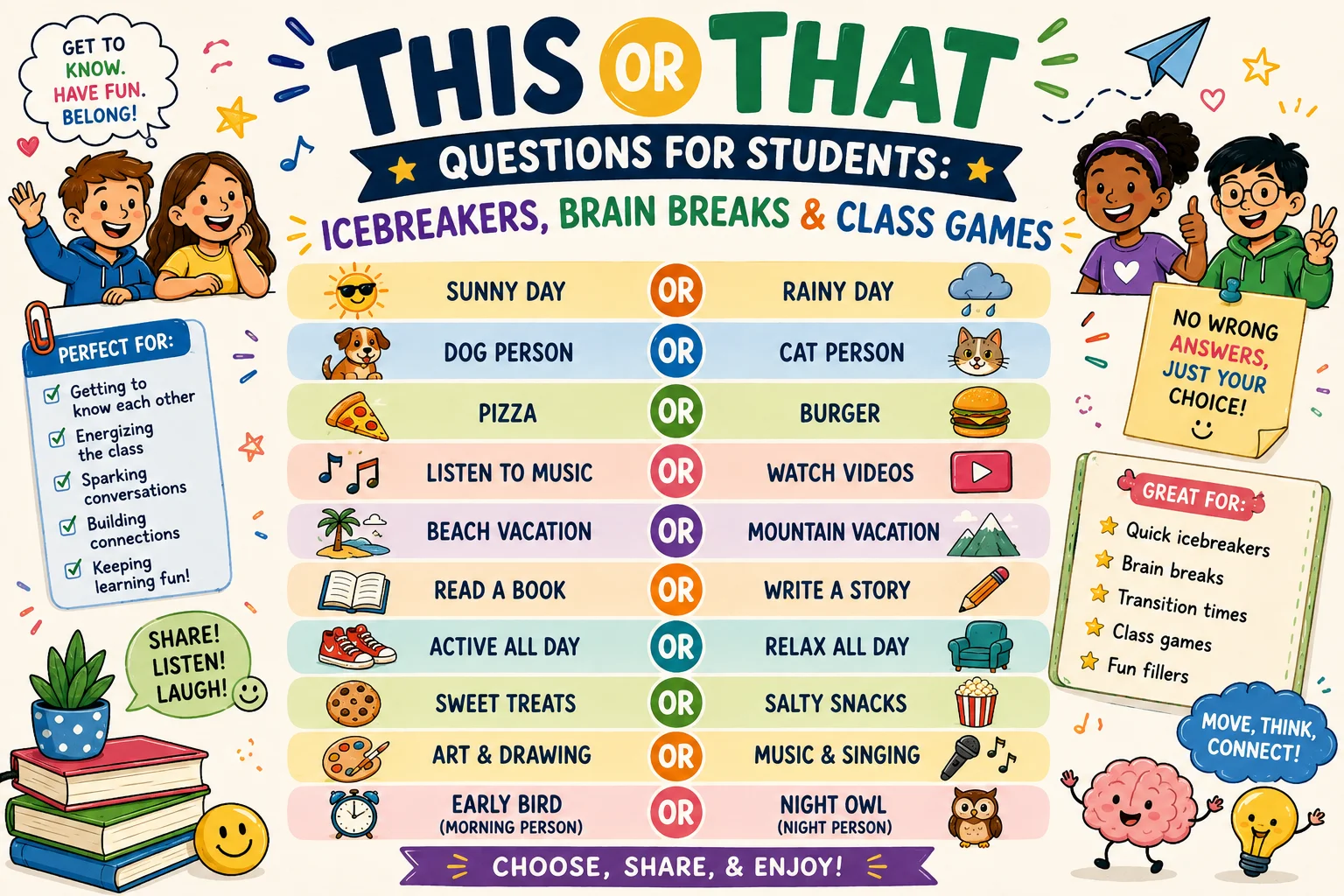
Why This Is Popular in Schools?
The classroom benefit isn’t just fun. It’s engagement architecture. Teachers who use this format regularly report higher voluntary participation, faster class transitions, and stronger peer familiarity within the first two weeks of school.
A few reasons the game keeps working:
- Low cognitive load. Students commit in under a second.
- Zero shame risk. Preferences aren’t right or wrong.
- Voice tolerance building. Students hear themselves speak in a safe setting, which lowers the barrier for higher-stakes speaking later.
- Rapid data collection. Teachers learn student personalities without formal assessment.
- Cross-age flexibility. The same format works from third grade to twelfth.
One insight most teacher guides skip: this game builds what educators call “response confidence.” Students who share opinions in low-stakes rounds become more willing to raise a hand during content lessons. That carryover effect shows up in participation rates within about three weeks of consistent use.
How to Play: Seven Classroom Formats
The rules stay simple, but the format you choose decides whether the game lands or flops. Here are seven versions that hold up in real classrooms.
1. Bell-Ringer Version
Post one question on the board. Students write their choice plus a one-sentence reason in their journal as they walk in. Takes 3 minutes. Great for settling energy.
2. Walk-the-Line Version
Read a question. Left side of the room = option A, right side = option B. Students physically move to their choice. Wakes up bodies after long sitting periods.
3. Popcorn Version
One student answers, then names the next student. Fast pace holds energy. Works best with groups of 15 or fewer.
4. Silent Vote Version
Students close eyes and raise hands. Removes peer influence. Useful when questions get more personal.
5. Partner Share Version
Pairs take turns asking each other from a curated list. Excellent for ESL, speech therapy, and get-to-know-you weeks.
6. Debate Extension Version
Two students pick opposite sides and each give a 30-second reason. Builds public speaking. Best for grades 6 and up.
7. Exit Ticket Version
End of class. Students write their choice on a sticky note and post it on the board on the way out. Doubles as informal formative assessment.
Quick Table Comparison
| Format | Group Size | Time | Best Use | Skill Built |
|---|---|---|---|---|
| Bell-Ringer | Any | 3–5 min | Class opener | Focus, writing |
| Walk-the-Line | 10–30 | 10 min | Brain break | Movement, choice |
| Popcorn | 5–15 | 5–10 min | Energy boost | Verbal fluency |
| Silent Vote | Any | 5 min | Sensitive prompts | Self-reflection |
| Partner Share | Any | 10–15 min | Speaking practice | Conversation |
| Debate | 5–20 | 15–20 min | Public speaking | Argument |
| Exit Ticket | Any | 3 min | Class closer | Reflection |
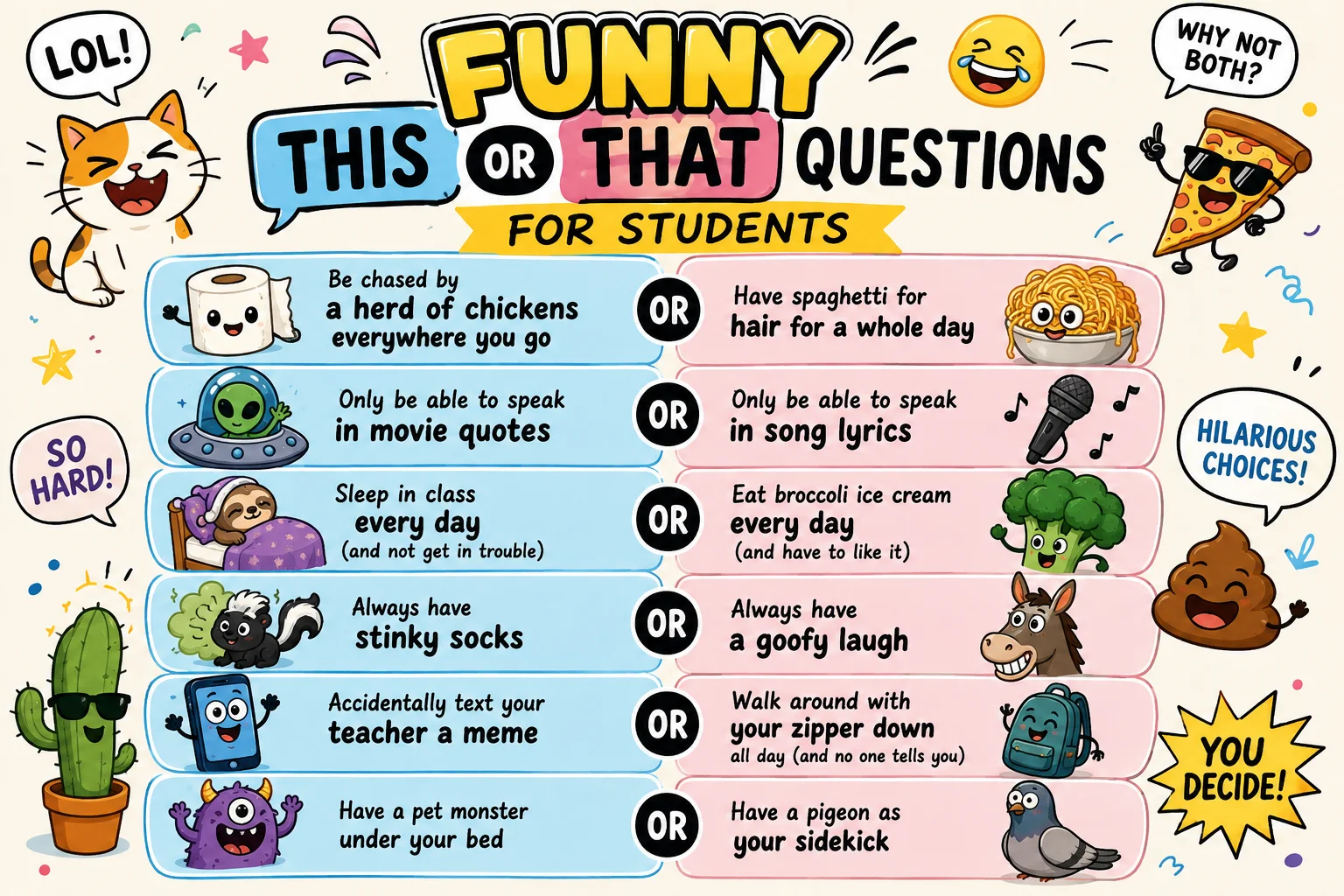
Funny This or That Questions for Students
Comedy is the fastest icebreaker in the room. Start here if your group is stiff, new to each other, or coming off a hard week.
- Fart in an elevator or burp during a class presentation?
- Slip on a banana peel or trip over your own shoelaces?
- Have hiccups for a day or sneeze every five minutes?
- Wear socks with sandals or a shirt inside out to school?
- Get chased by a goose or by 100 angry chickens?
- Talk like a pirate for a week or like a robot?
- Laugh at every serious moment or cry at every happy one?
- Trip in front of your crush or wave at someone who wasn’t waving?
- Sneeze glitter or hiccup bubbles?
- Ride a giant chicken or a tiny elephant?
- Snort when you laugh or scream when you laugh?
- Wear clown shoes for a week or a clown wig?
- Pet a dragon that farts fire or a unicorn that sneezes rainbows?
- Eat a spoonful of mustard or a spoonful of mayo?
- Have a cartoon voice or an old-man voice?
- Grow bunny ears or a monkey tail?
- Do a TikTok dance for your grandma or your principal?
- Get tickled for an hour or listen to a baby cry for an hour?
- Have spaghetti hair or meatball eyes?
- Sing every sentence or rhyme every sentence?
If your students love comedy, pair these with knock knock jokes for kids, baseball dad jokes, or football jokes for a full humor block.
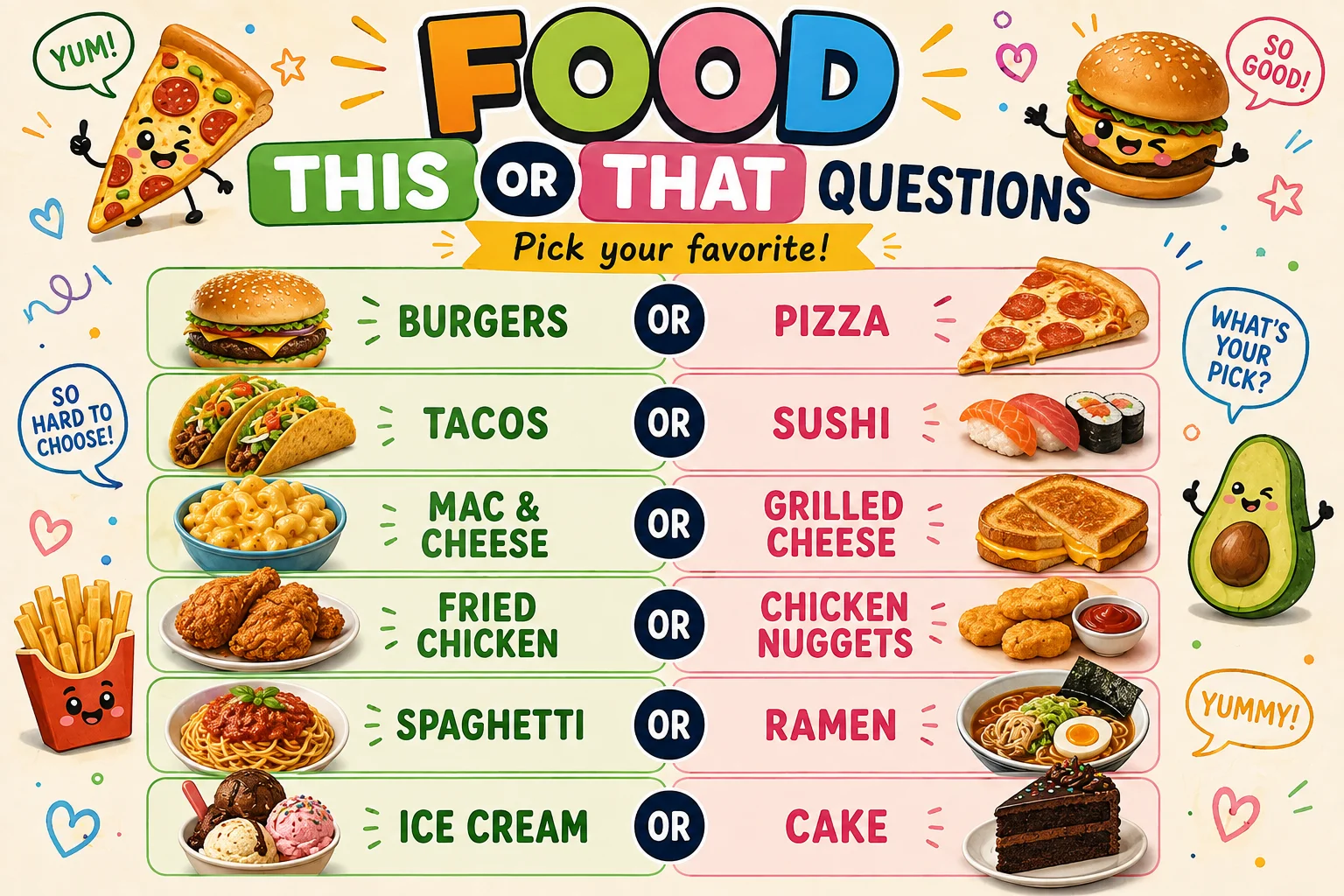
Food This or That Questions for Students
Food debates are the safest icebreaker in existence. Every student has opinions about lunch, snacks, and drive-thru favorites. There’s also a full this or that food questions collection with even more prompts.
- Pizza or tacos?
- Ice cream or milkshake?
- Chocolate or vanilla?
- Chicken nuggets or french fries?
- Cheeseburger or hot dog?
- Ranch or ketchup?
- Pancakes or waffles?
- Cereal or oatmeal?
- Sushi or ramen?
- Popcorn or nachos?
- Peanut butter or Nutella?
- Sweet or salty?
- Skittles or Starbursts?
- Oreos or Chips Ahoy?
- Hot Cheetos or Takis?
- Bubble tea or slushie?
- Chick-fil-A or Raising Cane’s?
- In-N-Out or Five Guys?
- Domino’s or Little Caesars?
- Pineapple on pizza or no pineapple?
- Chicken wings or chicken tenders?
- Sourdough or white bread?
- Fried rice or lo mein?
- Mac and cheese or grilled cheese?
- Strawberry or watermelon?
- Cake or pie?
- Chocolate chip cookies or sugar cookies?
- Root beer or Dr Pepper?
- Sparkling water or regular water?
- Cold pizza or reheated pizza?
School and Classroom Questions for Students
These land differently because students live this world every day. Perfect for the first week back, right before a break, or when a substitute needs a filler activity. If you want more targeted prompts, this this or that questions for back to school collection is worth bookmarking.
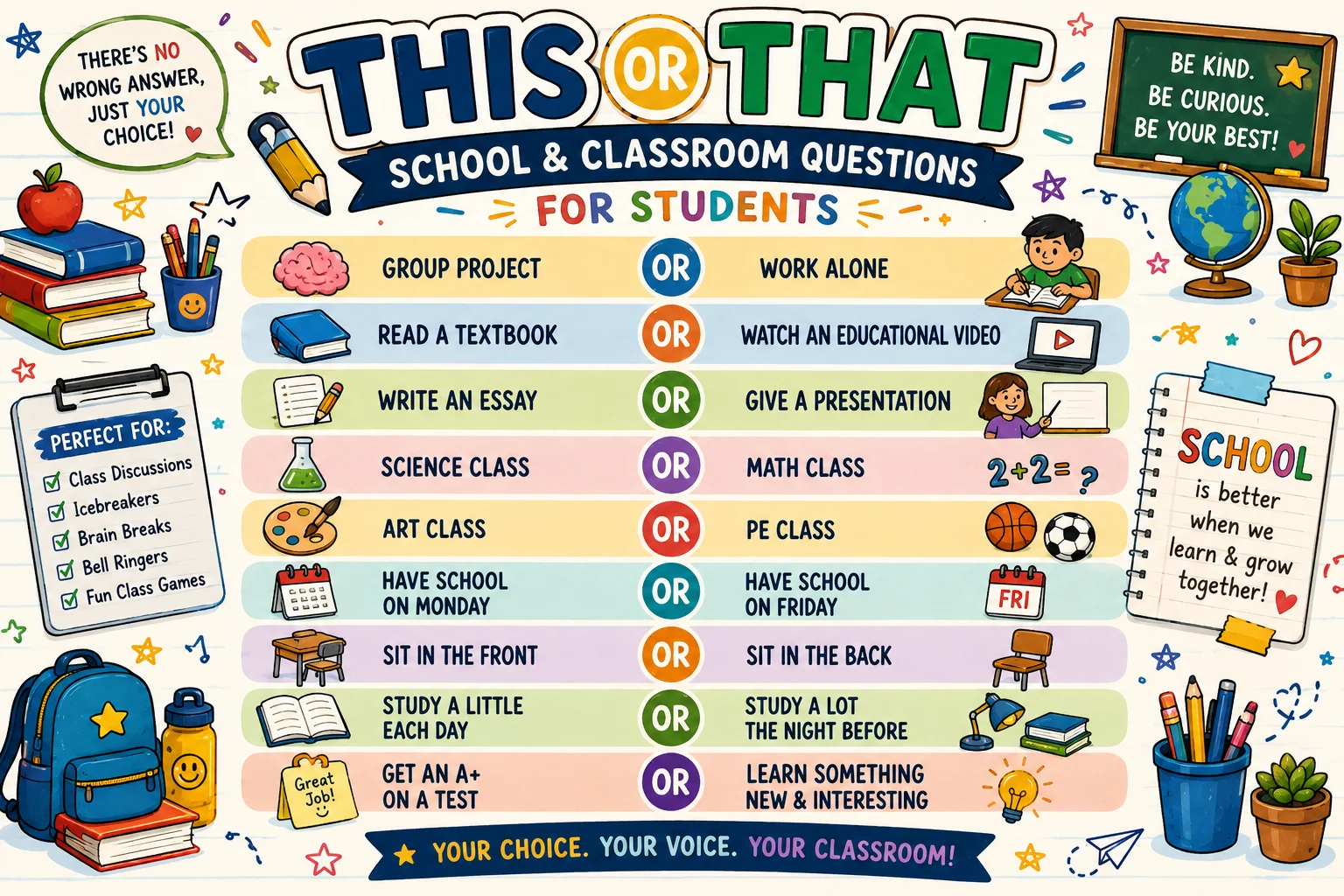
- Homework right after school or right before bed?
- Math or English?
- Pen or pencil?
- Sit in the front or the back?
- Group project or solo project?
- Substitute teacher or your usual teacher?
- Recess or lunch?
- Field trip or free day?
- Reading the book or watching the movie?
- Notebook or laptop?
- Textbook or online notes?
- Locker or backpack for everything?
- Cafeteria food or packed lunch?
- School bus or getting a ride?
- PE or art?
- Spelling test or math test?
- Presenting first or presenting last?
- Written essay or oral report?
- Science lab or history lecture?
- Study alone or study with friends?
- Highlighter or sticky notes?
- Cursive or print handwriting?
- Music class or drama class?
- Field day or picture day?
- Early bell or late bell?
For students who feel restless during long periods, these productive things to do in school when bored pair nicely. And if you’re working on academic mindset, this piece on motivational quotes for students to work hard fits alongside the school-themed questions.
Would-You-Rather Style Questions
These are close cousins of this or that with slightly bigger stakes. Bring them out once the group has warmed up.
- Never use the internet again or never watch TV again?
- Be invisible or be able to fly?
- Read minds or see the future?
- Live in space or live underwater?
- Have super speed or super strength?
- Never do homework or never take a test?
- Be famous for singing or famous for sports?
- Time travel to the past or the future?
- Have a giant house or a giant backyard?
- Own a private jet or a private island?
- Never sleep or never eat?
- Be the smartest or the funniest?
- Have $1 million now or $10 million in ten years?
- Live without music or without movies?
- Talk to animals or speak every language?
For longer imaginative discussions, this what if questions to ask set extends the theme nicely.
This or That Questions Pop Culture, Music, and Movies
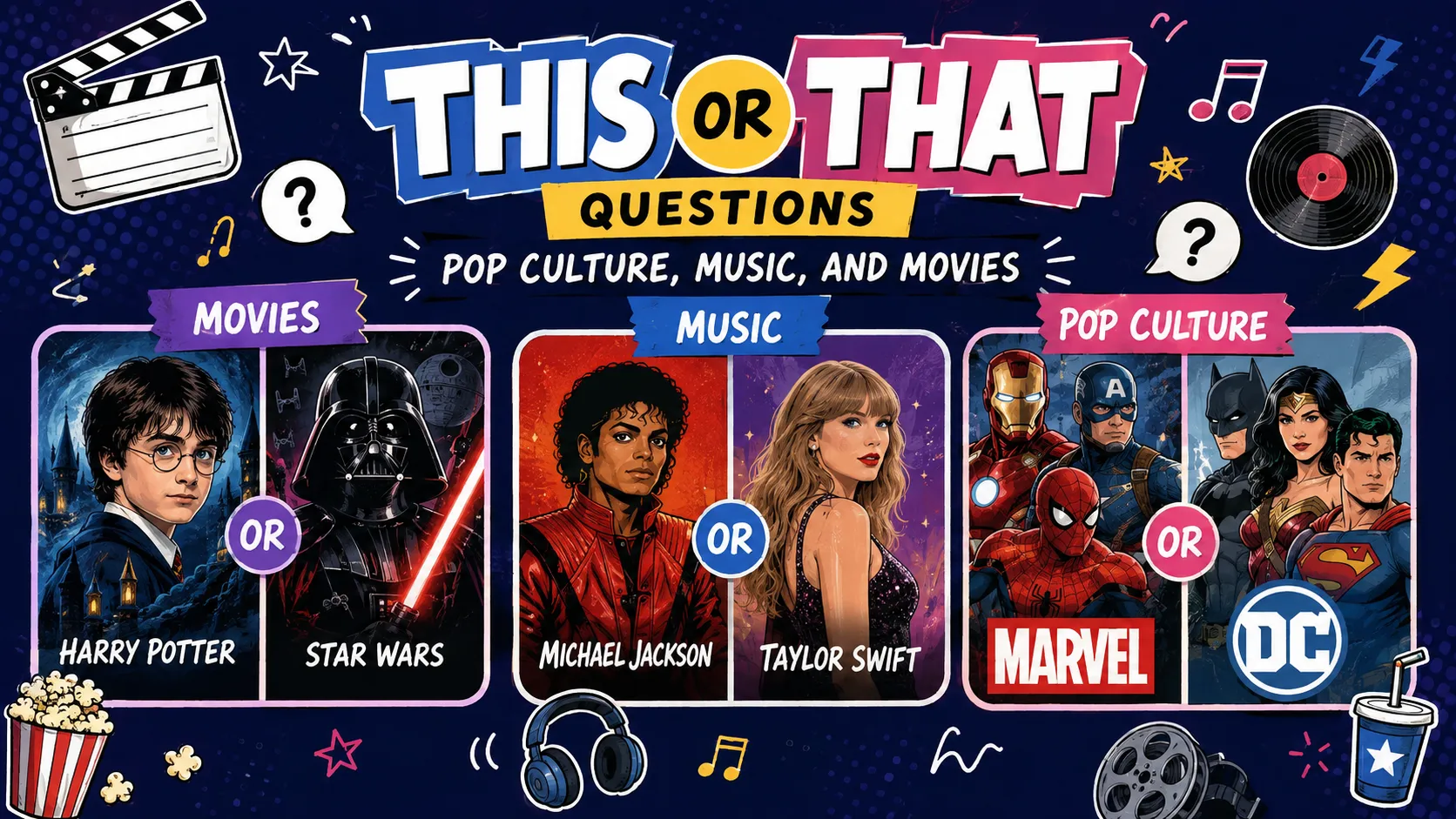
These pull the loudest reactions. Refresh them yearly because references age fast.
- Marvel or DC?
- Star Wars or Harry Potter?
- Netflix or Disney+?
- Spider-Man or Batman?
- Taylor Swift or Billie Eilish?
- Rap or pop?
- TikTok trends or YouTube shorts?
- Movie theater or watch at home?
- Animated or live action?
- Horror or comedy?
- Superhero movie or fantasy movie?
- Music with lyrics or instrumental?
- Album or single tracks?
- Concert or music festival?
- Podcast or audiobook?
- Read the book first or watch the movie first?
- Old Disney or new Disney?
- Anime or cartoons?
- Reality TV or scripted TV?
- K-pop or country?
Sports and Outdoor Questions for Students
Not every student is athletic, so mix competitive prompts with outdoor and recreational ones. Kids who don’t play still watch. There are also targeted sets like these this or that football players questions and the this or that questions world cup edition.
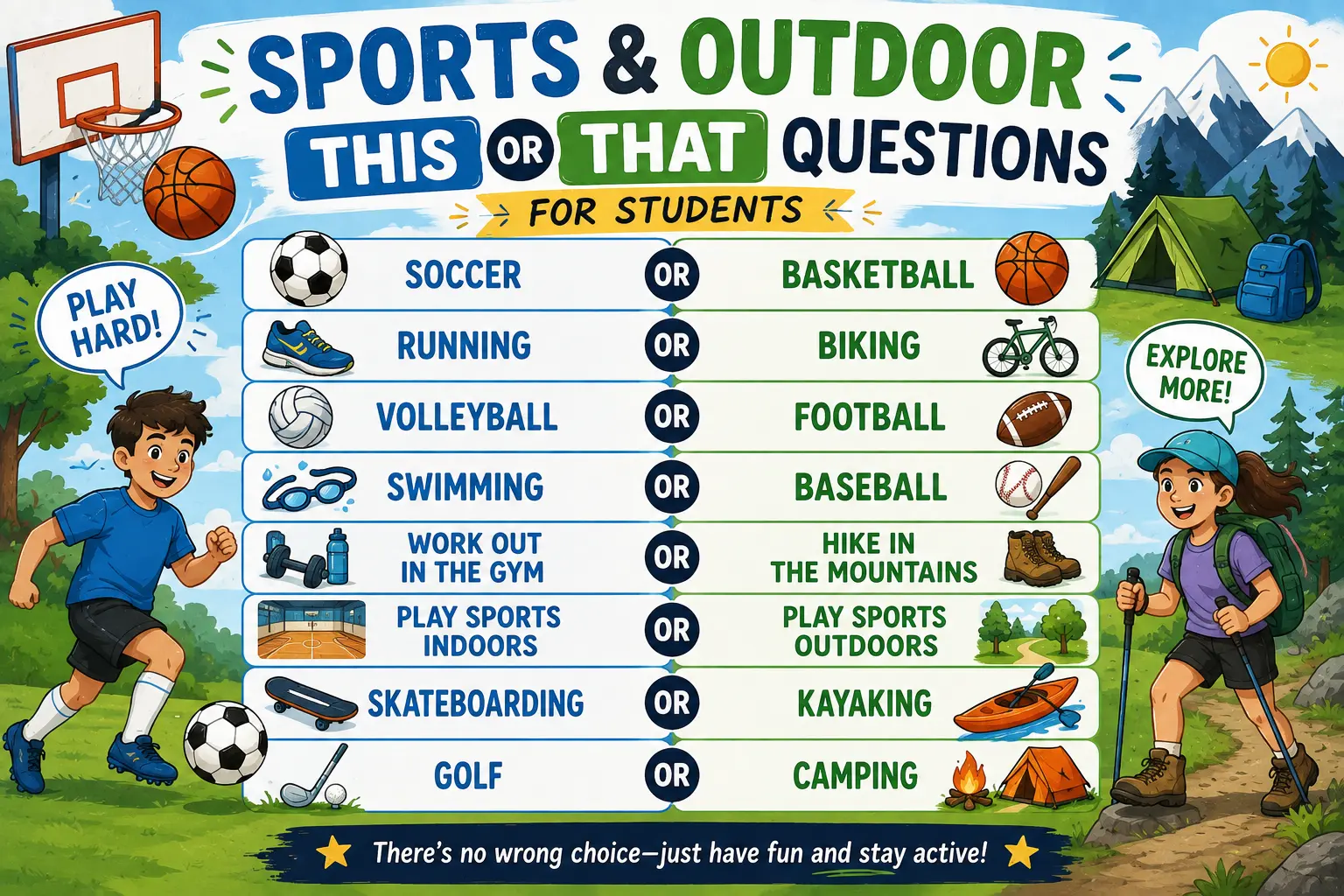
- Basketball or football?
- Soccer or baseball?
- Swimming or running?
- Team sport or individual sport?
- Watching sports or playing sports?
- Skateboard or scooter?
- Bike or roller skates?
- Hiking or biking?
- Snowboarding or skiing?
- Beach day or pool day?
- Camping in a tent or in a cabin?
- Fishing or kayaking?
- Trampoline park or laser tag?
- Bowling or mini golf?
- Playground or arcade?
- Rock climbing or ziplining?
- Track or gymnastics?
- Volleyball or tennis?
- Cheer or dance?
- Winning as a team or scoring the winning point yourself?
Technology, Gaming, and Social Media
This category gets loud reactions. Students debate consoles the way adults debate cars.
- iPhone or Android?
- Xbox or PlayStation?
- Nintendo Switch or PC gaming?
- Fortnite or Minecraft?
- Roblox or Among Us?
- Snapchat or Instagram?
- TikTok or YouTube?
- Texting or calling?
- Emoji or plain text?
- FaceTime or Zoom?
- Wireless earbuds or wired headphones?
- Smartwatch or regular watch?
- Tablet or laptop?
- Solo gaming or online multiplayer?
- Streaming or downloading?
- Console gaming or mobile gaming?
- Voice message or typed message?
- Group chat or one-on-one chat?
- Discord or Snapchat?
- Public account or private account?
If students use slang you can’t decode, these guides help: what does 67 mean in slang, what does wtw mean, what does otw mean in text, what does rs mean in text, and what does wtv mean in text.
Travel and Adventure Questions
Travel prompts work great before school breaks or during a geography unit. They also draw out family stories, which builds classroom trust.
- Beach vacation or mountain vacation?
- Road trip or plane trip?
- Big city or small town?
- Disneyland or Universal Studios?
- Camping or hotel?
- Cruise or resort?
- Theme park or water park?
- New York or Los Angeles?
- Paris or Tokyo?
- Cold destination or hot destination?
- Explore somewhere new or return to a favorite place?
- Take pictures or just enjoy the moment?
- Souvenirs or photos?
- Guided tour or explore on your own?
- Trains or buses?
- Backpack or suitcase?
- Long trip once a year or short trips often?
- Visit family or travel with friends?
- Museum or amusement park?
- Beach house or lake house?
Animals and Nature Questions
Animal prompts are pure gold across every grade level. Even the too-cool kids soften when the topic turns to pets.
- Dogs or cats?
- Bunny or hamster?
- Golden retriever or husky?
- Turtles or fish?
- Lion or tiger?
- Shark or dolphin?
- Butterflies or ladybugs?
- Farm animals or wild animals?
- Zoo or aquarium?
- Cheetah or eagle?
- Panda or koala?
- Snake or lizard?
- Owl or hawk?
- Elephant or giraffe?
- Horse or unicorn?
- Bees or butterflies?
- Rain or snow?
- Sunrise or sunset?
- Ocean or lake?
- Forest or desert?
Holiday and Seasonal Questions
Rotate these throughout the year. They give class parties instant structure. There’s a full this or that questions for Halloween set for October and a trick or treat quote collection to pair with it.
- Halloween or Christmas?
- Thanksgiving or Fourth of July?
- Valentine’s Day or Easter?
- Trick-or-treating or a Halloween party?
- Group costume or solo costume?
- Snow day or beach day?
- Summer break or winter break?
- Fireworks or sparklers?
- Christmas Eve or Christmas morning presents?
- Real Christmas tree or fake tree?
- Handmade gifts or store-bought?
- Pumpkin pie or apple pie?
- Hot chocolate or apple cider?
- Snowman or snowball fight?
- Spring or fall?
- Family holiday or friend holiday?
- Decorating the tree or wrapping presents?
- Scary Halloween or funny Halloween?
- Egg hunt or pumpkin patch?
- Fourth of July parade or fireworks show?
Deeper Reflection Questions
Save these for later in the year once trust is built. They’re still simple prompts, but they reveal how students think. Great for advisory, morning meeting, and SEL blocks.
- Popular or respected?
- Rich or famous?
- Best friend or big group of friends?
- Success or happiness?
- Being right or being kind?
- Freedom or safety?
- Adventure or comfort?
- Talent or hard work?
- Winning or having fun?
- Follow the rules or break them for a good reason?
- Alone or around people?
- Know the truth or feel happy?
- Being feared or being loved?
- Living in the moment or planning ahead?
- Speaking up or listening?
These pair well with lessons on building self-confidence, personal growth tips, how to overcome fear of failure, and goal-setting strategies for success.
Friendship and Personality Questions
These help students learn about each other without pressure. Perfect for advisory or SEL blocks.
- Loyal friend or funny friend?
- Introvert or extrovert?
- Leader or follower?
- Planner or spontaneous?
- Morning person or night owl?
- Optimist or realist?
- Small hangout or big party?
- Text a friend or call them?
- Longtime best friend or new best friend?
- Talk it out or write it out?
- Say sorry first or wait?
- Give advice or listen?
- Trust easily or take your time?
- Loud friend or chill friend?
- Cry when sad or laugh it off?
For students who struggle socially, this piece on how to make new friends, plus how to start a conversation with a new person and motivation for students who don’t have friends at school, are helpful companion reads.
Weird and Random Questions
Save these for when energy dips. They’re the fastest way to get a laugh out of a quiet room.
- Talk to plants or talk to rocks?
- Live in a treehouse or an underground bunker?
- Have square feet or triangle hands?
- Only pizza forever or only ice cream forever?
- Meet a ghost or meet an alien?
- Skip breakfast or skip dinner?
- House made of candy or car made of jello?
- Speak in rhymes or sing every sentence?
- Wear a cape everywhere or a crown everywhere?
- Sleep in a hammock or a bathtub?
- Ten tiny fingers or two giant thumbs?
- Always know the time or always know the weather?
- Have a personal chef or a personal driver?
- Own a robot dog or a robot best friend?
- Never lose your phone or never lose your keys?
Adapting the Game Across Grade Levels
One list doesn’t fit every classroom. The same core format works from third grade through twelfth, but the question mix has to shift with the group.
Elementary (Grades 3–5)
Stick with food, animals, weather, and playground topics. Avoid anything abstract. A prompt like “popular or respected?” makes no sense to a nine-year-old. There’s a dedicated this or that questions for elementary students set that stays age-appropriate. For the youngest students, this this or that questions for kindergarten list is even simpler.
Middle School (Grades 6–8)
This is the sweet spot. Kids can handle silly prompts and deeper ones in the same session. Mix comedy with reflection. See the full this or that questions for middle schoolers list for a targeted set.
High School (Grades 9–12)
Older students want prompts with more nuance. Career, identity, and values-based questions land here. Skip the baby-food debates. This this or that questions for high school students collection matches the maturity level.
Comparison at a Glance
| Grade Band | Best Topics | Time Sweet Spot | Format That Works |
|---|---|---|---|
| Elementary | Animals, food, colors, weather | 5–7 min | Walk-the-Line, Popcorn |
| Middle | Food, tech, pop culture, personality | 10–15 min | All formats |
| High School | Values, careers, deeper reflection | 15–20 min | Debate, Silent Vote |
Tips for Teachers, Tutors, and Youth Leaders
Running this game well isn’t complicated, but small choices decide whether it lands or flops.
Read the room first. A third-grade class in September needs safer prompts than a senior advisory in April. Start silly, get deeper as trust builds.
Skip the “why” at first. New groups clam up when asked to explain. For the first few rounds, take the answer and move on. Kids will start explaining on their own once they relax.
Offer a pass. Every student should be allowed one pass per session. This protects kids who feel put on the spot.
Watch the pace. Fast beats slow. If a question takes more than 15 seconds, cut it.
Avoid loaded topics. Politics, religion, income, and appearance don’t belong in the classroom version. Preferences, hobbies, and fun scenarios are the safe zone.
Use it short. Ten minutes at the start of class beats a full 45-minute session. Kids stay hungry for more.
Pair with movement. The walk-the-line version wakes up bodies after lunch and gets non-verbal students participating with their feet.
Track the winners. Keep a running list of questions that got the biggest reactions. Reuse them the following year.
Common Mistakes to Avoid
A few things quietly kill the fun. Watch for these.
- Making questions too broad. “Good or bad?” isn’t a real choice. Always give two specific options.
- Letting one student dominate. Set a rule: one answer per person, then move on.
- Reading questions in the same order every time. Kids catch on. Shuffle the list.
- Ignoring cultural context. A question about a specific holiday or food might exclude some students. Mix in universal options.
- Turning it into a courtroom. Nobody needs to defend their choice unless they want to.
- Using questions that shame. Anything targeting body, family, or income has no place here.
- Running it too long. Twenty minutes max in a classroom. Longer and the magic fades.
- Skipping the debrief. After deeper prompts, take 60 seconds to ask what students noticed about the class’s answers. That’s where the real learning happens.
Sample Starter Pack
Here’s a balanced 10-question sample pulled from the sets above. Use it if you want a ready-made round for tomorrow.
| Category | Question | Best Setting |
|---|---|---|
| Funny | Sneeze glitter or hiccup bubbles? | Icebreaker |
| Food | Pineapple on pizza or not? | Class party |
| School | Sit in the front or the back? | First day |
| Reflection | Popular or respected? | Advisory |
| Tech | iPhone or Android? | Brain break |
| Animals | Dogs or cats? | Any grade |
| Holiday | Halloween or Christmas? | Seasonal |
| Random | Live in a treehouse or a bunker? | Slow moments |
| Personality | Introvert or extrovert? | SEL block |
| Adventure | Beach or mountains? | Pre-break |
Related Resources Worth Bookmarking
If this list is your entry point, these collections extend the theme naturally:
- This or that questions — the master list for all ages
- This or that questions for middle schoolers — grade 6–8 focused
- This or that questions for high school students — teen-appropriate
- This or that questions for elementary students — grades 3–5
- This or that questions for kindergarten — youngest learners
- This or that questions for back to school — first-week prompts
- This or that questions for family — road trips and dinners
- This or that questions for boys and this or that questions for girls — themed sets
- Truth or dare questions — for older students at parties
- What if questions to ask — imaginative extensions
- Small talk questions — for conversation practice
- Fun conversation topics — for longer discussions
- Trap questions to get to know someone — for advanced groups
FAQ
Are this or that questions appropriate for students of all ages?
Yes, when the topics stay away from politics, religion, appearance, income, and family structure, this or that questions are appropriate from kindergarten through high school. The trick is matching the topic to the developmental stage. Younger students need concrete choices (dogs or cats). Older students can handle abstract ones (freedom or safety).
How many questions should I use in one classroom session?
Ten to fifteen is the sweet spot for a classroom warmup. That’s about 5–10 minutes. For a party, sleepover, or club meeting, 30–50 questions can carry a full hour. Any more and students start to zone out. Better to stop while they still want more.
Can this or that questions be used for real learning, not just fun?
Yes. Teachers use them as bell-ringers, journal prompts, formative assessment, and discussion starters. A question like “would you rather live in the past or the future?” can lead into a history assignment. “Book or movie?” opens a lesson on adaptation and point of view. The format is more flexible than it looks.
How do I get shy students to participate?
Start with the silliest prompts first. Let students answer with a thumbs up or thumbs down instead of speaking. Use the walk-the-line version so answering doesn’t require words. Always offer a pass. Most shy students join in by the third round once they see nobody’s being judged.
What topics should I avoid in the classroom?
Skip questions about body type, family income, dating, alcohol, drugs, politics, religion, and anything comparing students to each other. Also avoid prompts that force a student to reveal something private, like “parents divorced or married?” The goal is connection, not exposure.
Can I use these for online or virtual classes?
Yes. This or that works well over Zoom, Google Meet, or Microsoft Teams. Use the chat for quick A/B voting or built-in polls. It’s one of the few icebreakers that keeps energy on a screen because answers are so short. Emoji reactions also work well for silent voting.
How often should I use this game with the same group?
Once or twice a week is plenty. Daily use dulls the novelty. Pull it out on Mondays to restart the week, Fridays to close it, or before breaks to burn off excitement. Rotating categories also keeps it fresh across the school year.
What’s the difference between “this or that” and “would you rather”?
This or that focuses on preferences between two real things (pizza or tacos). Would you rather often adds a hypothetical or extreme twist (would you rather have super speed or super strength). Students enjoy both, and the two formats blend well in the same session.
Do I need to prepare answers ahead of time?
No. There’s no right answer. Just have your question list ready. If a student asks what you’d pick, answer honestly. Students appreciate a teacher who plays along, and it models that opinions are welcome.
Can this format help English Language Learners?
Yes. Speech-language pathologists and ESL instructors use this or that questions because the format lowers the speaking barrier. Students only need to say one word or phrase to participate. It’s one of the most researched low-stakes verbal warmups for language acquisition.
What if students disagree strongly about a choice?
That’s a win. Disagreement is where learning happens. Use it as a segue into a short debate exercise or a writing prompt. Just keep the tone light. Remind students that different choices don’t mean anyone is wrong.
Conclusion
This or that questions are one of the simplest and highest-leverage tools a teacher, tutor, or parent can keep in their back pocket. They cost nothing, require no prep, and reliably get students of any age talking. The 250+ questions above cover every category you’ll realistically need across a full school year, from first-day icebreakers to holiday parties, from morning meetings to Friday exit tickets.
The real payoff shows up over time. Students who answer silly questions in September start sharing real thoughts by December. Classrooms that play together build trust that shows up in group projects and class discussions. Teachers who use these consistently notice something quiet but powerful: their students speak up more, listen better, and remember each other’s answers weeks later.
Pick 10 questions from the list, try them tomorrow, and pay attention to which ones get the biggest reactions. Those are the ones to keep. The rest you can rotate as your group grows and changes throughout the school year.
You May Also Like
 Fun Questions
1500+ This or That Questions for 2026: From Silly Choices to Deep Conversations
 Fun Questions
What Does WSG Mean in Text? How to Respond to WSG in Messages and Social Media
 Fun Questions
350+ Truth or Dare Questions: Play Classic Party Games With Your Friends
 Fun Questions
250+ This or That Questions for Back to School: The Ultimate Icebreaker Guide for Teachers and Students
 Fun Questions
157+ This or That Questions for Cousins: Fun Conversations
 Fun Questions
155+ This or That Questions for Black People: A Complete Cultural Connection Guide
 Fun Questions
What Does GNG Mean in Text? Meaning Slang, Examples, and Real Usage
 Fun Questions
What Does SYBAU Mean? SYBAU Slang Meaning, Origin & Examples
 Fun Questions